What is GameFi.org (GAFI)? Token Utility, Staking Tiers, and Risks Explained
 Aug, 13 2026
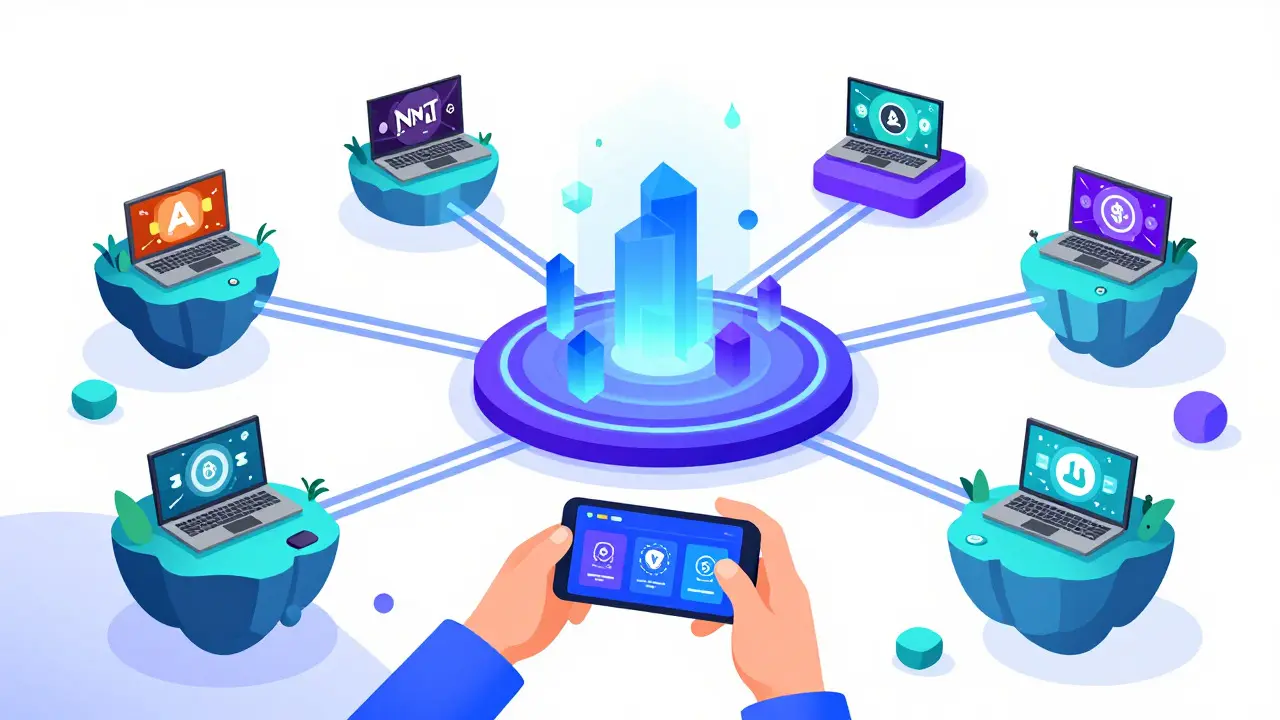
Remember when buying a sword in an online game meant your money just vanished into the developer’s pocket? That era is fading. Today, GameFi.org is a comprehensive blockchain gaming ecosystem platform established in August 2021 that integrates decentralized finance (DeFi) principles with gaming experiences. It operates as a central hub where every click, trade, or battle can have real-world economic value. But here is the catch: not all gaming platforms are created equal. Some are massive worlds like The Sandbox, while others, like GameFi.org, act more like a service provider for multiple games.
If you are holding GAFI tokens or thinking about staking them to access new game launches, you need to understand exactly how this machine works. Is it a solid investment, or is it a risky bet on a niche aggregator model? Let's break down the mechanics, the rewards, and the red flags so you can make a move with your eyes open.
The Core Concept: An Aggregator, Not Just a Game
Most people confuse GameFi platforms. You have standalone games like Axie Infinity, where you play one specific title. Then you have aggregators. GameFi.org falls into the latter category. Think of it less like a video game and more like a stock exchange mixed with a guild management tool.
Founded in August 2021, the platform aims to be a "centralized hub" for blockchain gaming. It doesn't necessarily build the best graphics or the most addictive gameplay itself. Instead, it provides the infrastructure. Its main components include:
- Launchpad: This is the bread and butter. It allows new blockchain games to raise funds through Initial DEX Offerings (IDOs) and Initial NFT Offerings (INOs). Users stake GAFI tokens to get early access to these projects.
- Marketplace: A place to trade in-game assets across different titles supported by the ecosystem.
- Guild Hub: Tools for communities to manage players and distribute rewards, similar to how big guilds operate in traditional MMOs but with smart contracts.
- Aggregator: A dashboard that lets you track your NFTs and earnings from various games in one spot, simplifying the messy world of Web3 wallets.
This approach has a clear advantage: convenience. If you want exposure to ten different upcoming crypto games without managing ten separate websites, GameFi.org offers a single interface. However, it also means the platform's success depends entirely on other developers choosing to build on its rails. As of late 2024, only three verified game studios were deeply integrated, which raises questions about long-term growth compared to giants like Gala Games who own their entire ecosystems.
Understanding the GAFI Token Economics
The GAFI token is the fuel for this engine. Without it, you are just a spectator. Here are the hard numbers you need to know before committing any capital.
| Metric | Value | Context |
|---|---|---|
| Total Supply | 14,954,970 | Fixed supply; no inflation from minting new tokens. |
| Circulating Supply | ~10.9 million | Approximately 73% of total supply is in circulation. |
| Price | $0.83 USD | Highly volatile; subject to broader crypto market trends. |
| Market Cap | $9.1 million | Ranks #1852 on CoinGecko; significantly smaller than competitors. |
| Daily Volume | $42,600 | Low liquidity; large trades may slip prices significantly. |
The fixed supply of roughly 15 million tokens is a double-edged sword. On one hand, scarcity can drive price up if demand increases. On the other hand, there is no mechanism to print new tokens to fund future development or rewards unless they are recycled from existing holders. This creates what experts call "inflationary pressure" on the circulating supply because rewards must come from somewhere-usually transaction fees or buybacks.
Compared to SAND (The Sandbox), which had a market cap over $1 billion in late 2024, GAFI is a micro-cap asset. This means it carries higher risk but potentially higher reward if the platform gains traction. The low trading volume ($42k daily) is a warning sign: getting in is easy, but getting out with a large position might crash the price.
How Staking Works: Tiers and Rewards
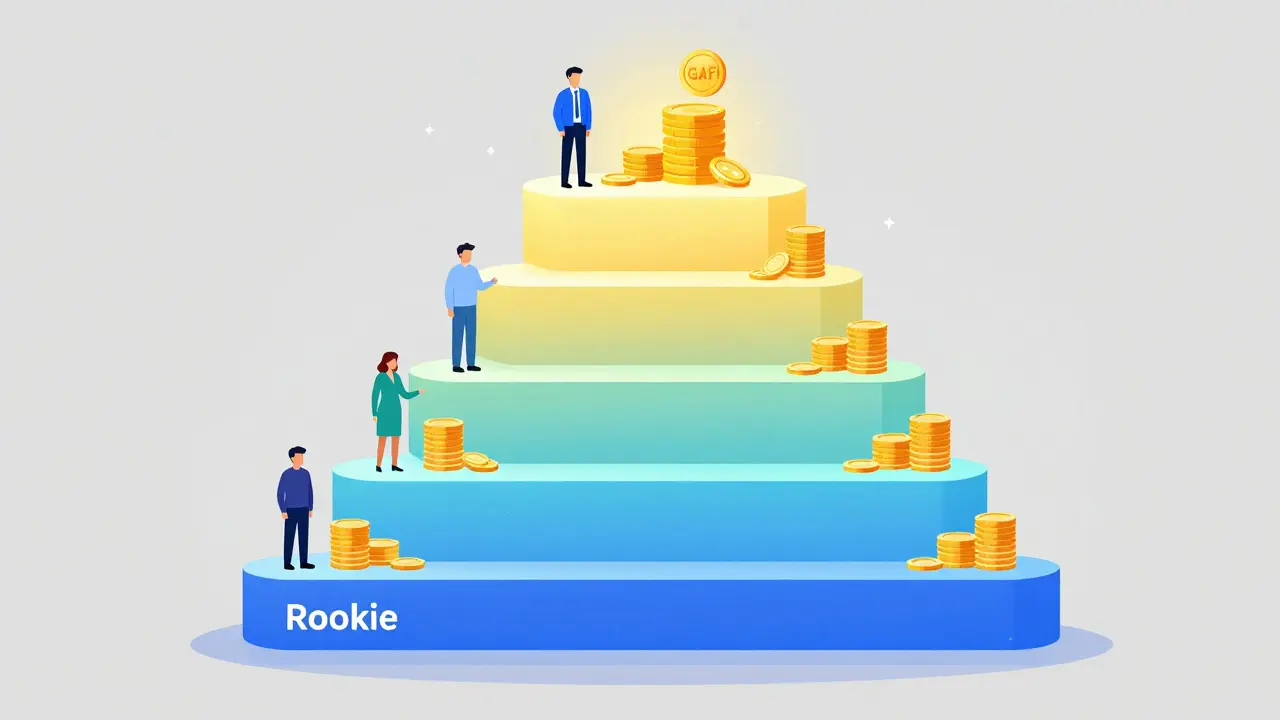
You don't just hold GAFI; you stake it. Staking locks your tokens up to prove commitment and unlock privileges. The system uses a five-tier ranking structure:
- Rookie: Entry-level access. Minimal benefits.
- Elite: Better allocation sizes in launchpads.
- Pro: Enhanced visibility and slightly faster processing.
- Pro Max: Priority support and larger IDO allocations.
- Legend: Top-tier governance rights and maximum allocation limits.
Each tier requires a minimum amount of GAFI. While exact figures fluctuate based on token price, the principle remains: more skin in the game equals more perks. The reward mechanism is precise. You earn loyalty points calculated at 0.5% of your staking amount multiplied by the number of days staked. These points represent your cumulative standing and determine your eligibility for whitelists.
However, there is a major friction point: cooldown periods. When you unstake, you cannot withdraw your tokens immediately. Depending on your rank, delays range from 12 hours to 72 hours. For active traders, this illiquidity is a dealbreaker. If Bitcoin crashes 20% in an hour, you might be stuck watching your portfolio bleed while locked in the staking contract.
Is GameFi.org Worth Your Time? Pros and Cons
Let's look at the reality on the ground. User sentiment is polarized. On Trustpilot, the platform holds a 2.8/5 rating. Why such a split?
The Good:
- Simplicity: Managing multiple NFTs across different chains is a nightmare. GameFi.org's aggregator feature solves this by centralizing your view.
- Transparent Progression: Unlike some vague DAOs, the tier system is clear. You know exactly what you need to stake to reach the next level.
- Early Wins: Some users report massive returns. One Reddit user documented a 47x return from a $500 stake used to access a presale in March 2023. These stories exist, but they are outliers.
The Bad:
- Liquidity Issues: With only $42k in daily volume, slippage is real. Buying $1,000 worth of GAFI could push the price up noticeably.
- High Barriers: To get meaningful allocations in high-demand IDOs, you often need to stake thousands of dollars worth of tokens. This contradicts the "decentralized" ethos by favoring whales.
- Small Community: With only ~4,800 active social followers, the network effect is weak. Compare this to The Sandbox's 247,000 followers. Fewer users mean fewer games launching, which means less utility for your token.
Expert Michael Chen criticized the platform in September 2024, noting that the high staking requirements create "barriers to entry that contradict decentralized finance principles." Conversely, analyst Sarah Johnson praised the structured progression, arguing it filters out bots and ensures serious participants.
Technical Requirements and Getting Started
If you decide to proceed, you need to meet certain technical criteria. GameFi.org runs on Ethereum Virtual Machine (EVM) compatible chains. This means you will need a wallet like MetaMask or Trust Wallet. There is no native mobile app yet, though one was planned for Q3 2024.
The onboarding process takes about 3-5 hours for someone familiar with crypto. It involves:
- Connecting your wallet to the GameFi.org dashboard.
- Purchasing GAFI tokens from an exchange like Gate.io or Uniswap.
- Staking your tokens to achieve a desired tier.
- Completing KYC (Know Your Customer) verification if you want to participate in IDOs. This is crucial for regulatory compliance but adds friction for privacy-focused users.
Common pitfalls include running out of gas fees for transactions or failing to clear browser cache when the interface glitches. Support response times average 18.7 hours, so expect to troubleshoot minor issues yourself.
Future Outlook and Risks
The GameFi industry is projected to grow at a 21.7% CAGR through 2030, reaching $8.1 billion. GameFi.org currently captures a tiny slice-about 0.11%-of this pie. Their roadmap for Q4 2024 includes cross-chain bridging and dynamic staking rewards, aiming to fix the liquidity and rigidity issues mentioned earlier.
However, the risks are significant. The platform relies heavily on attracting new game developers. Without exclusive partnerships, it struggles against incumbents. Regulatory uncertainty around governance tokens also looms large. If regulators classify GAFI as a security rather than a utility token, the implications for trading and staking could be severe.
For the average user, GameFi.org is not a set-and-forget investment. It is a tool for active participants who want early access to gaming projects. If you are looking for passive income with low risk, look elsewhere. If you are a savvy gamer willing to navigate complex staking tiers and accept illiquidity for the chance at high-reward IDOs, GAFI offers a structured path in.
What is the primary use case for the GAFI token?
The GAFI token is primarily used for staking to gain access to the GameFi.org Launchpad. By staking GAFI, users unlock different tiers (Rookie to Legend) which grant them allocation rights in Initial DEX Offerings (IDOs) and Initial NFT Offerings (INOs) for new blockchain games. It also serves as a governance token within the ecosystem.
Is GameFi.org a safe investment?
Like all cryptocurrencies, GAFI carries significant risk. It has a low market cap (~$9 million) and low daily trading volume (~$42k), which leads to high volatility and potential slippage. Additionally, the platform's success depends on attracting new game developers, which has been slow. It is considered a high-risk, high-reward asset suitable only for experienced crypto users.
How do I earn rewards with GAFI?
Rewards are earned through staking. The system calculates loyalty points at 0.5% of your staked amount per day. These points determine your rank and eligibility for whitelists in new game launches. Higher ranks (Pro Max, Legend) receive larger allocations and priority support. Note that unstaking involves a cooldown period of 12 to 72 hours depending on your tier.
What is the difference between GameFi.org and The Sandbox?
The Sandbox is a standalone virtual world and game creation platform with its own massive user base and economy. GameFi.org is an aggregator and launchpad. It does not focus on building one specific game but rather provides infrastructure (launchpads, marketplaces, guild tools) for multiple different games to launch and operate. GameFi.org is much smaller in market cap and user count.
Do I need to complete KYC to use GameFi.org?
Yes, if you want to participate in Initial Game Offerings (IGOs) or IDOs through the Launchpad, you typically need to complete Know Your Customer (KYC) verification. This is required for regulatory compliance. Basic browsing and marketplace usage may not require it, but core earning features usually do.