What is KernelDAO (KERNEL) Crypto Coin? A Clear Guide to Restaking and Multi-Chain Yield
 Jan, 16 2026
KernelDAO isn’t just another crypto coin. It’s a system built to make your staked assets work harder-across multiple blockchains at once. If you’ve ever felt like your ETH or BNB is sitting idle after staking, KernelDAO (KERNEL) is designed to fix that. Launched in April 2025, it’s not asking you to lock up more money. It’s asking you to reuse what you already have.
What KernelDAO Actually Does
Traditional staking locks your crypto to one chain. You stake ETH on Ethereum, and that’s it. Your ETH earns rewards, but it’s stuck. KernelDAO changes that. It lets you take assets you’ve already staked-like stETH or rsETH-and use them again to earn more rewards on other networks. This is called restaking.
Think of it like renting out your apartment. Instead of just living in it, you let someone else use it while you still keep the keys. KernelDAO does the same with crypto. Your staked ETH becomes a tool that secures other services, and you get paid twice: once for original staking, once for restaking.
The protocol connects three groups:
- Token holders who want more yield
- Validators who need more security deposits
- Actively Validated Services (AVS) that need reliable, decentralized validation
It’s not magic. It’s math. And it’s working. As of December 2025, KernelDAO had over $2 billion locked in its system-making it one of the top restaking protocols after EigenLayer.
The KERNEL Token: More Than Just a Coin
The KERNEL token isn’t just for trading. It’s the engine that runs the whole system. It has three real jobs:
- Governance - Holders vote on which chains to add next, how rewards are distributed, and who gets to validate.
- Incentives - Users and validators earn KERNEL tokens for participating in the network.
- Staking - Locking KERNEL gives you higher rewards and more voting power.
Unlike some tokens that are just speculative, KERNEL has utility baked in. If you’re active on the protocol, you’ll likely earn it. If you hold it, you help shape its future.
Three Products, One Ecosystem
KernelDAO doesn’t offer one tool. It offers three:
Kernel - Restaking on BNB Chain
This is the entry point. You deposit liquid staking tokens like stETH, and Kernel restakes them across services on BNB Chain. It’s the most popular option for users already active on BNB Chain, which makes up 68% of KernelDAO’s user base.
Kelp - Liquid Restaking for Ethereum
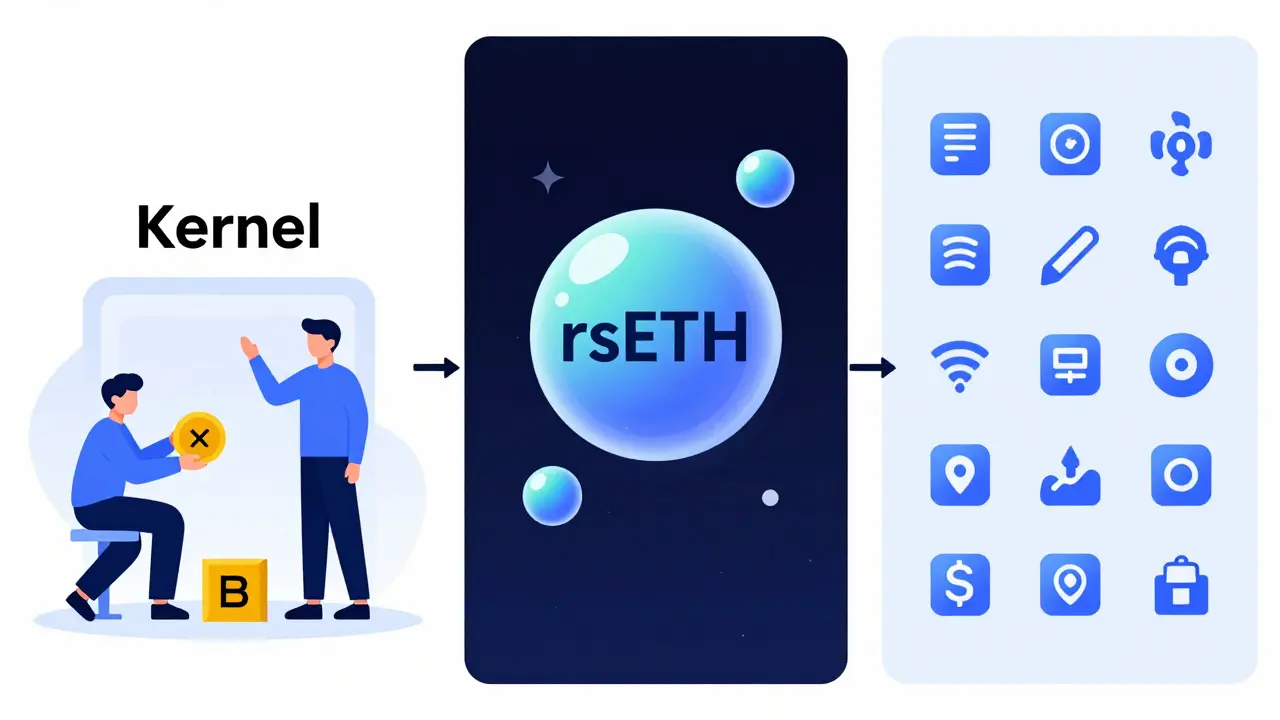
Kelp lets you stake ETH and get rsETH back. rsETH is a liquid token that keeps your ETH usable-you can trade it, lend it, or use it in DeFi-while still earning staking rewards. It’s like having your cake and eating it too.
Gain - Automated Yield Farming
Gain takes your assets and automatically moves them across 50+ DeFi protocols to chase the highest yields. It’s not manual. You set your risk level, and it does the rest. Since its automated compounding update in November 2025, users have seen yield boosts of 1.2% to 1.8% APY.
Most users start with Kernel or Kelp. Gain is for those who want to go deeper.
How KernelDAO Compares to the Competition
KernelDAO isn’t the only restaking protocol. But it’s one of the few that works across multiple chains.
| Protocol | Primary Chain | TVL | Multi-Chain? | Best For |
|---|---|---|---|---|
| KernelDAO | Ethereum, BNB Chain, Arbitrum | $2B+ | Yes (10+ chains) | Users on BNB Chain, multi-chain yield seekers |
| EigenLayer | Ethereum | $15.7B | No | Large-scale Ethereum security, institutional users |
| Renzo | Ethereum | $1.2B | No | Liquid restaking on Ethereum only |
| Puffer Finance | Ethereum | $850M | No | Simple ETH restaking, beginner-friendly |
KernelDAO’s edge? It’s not trying to beat EigenLayer at its own game. It’s building a different one. While EigenLayer dominates Ethereum, KernelDAO is the go-to for users who want to earn across BNB Chain, Arbitrum, and others. If you’re already using BNB Chain for DeFi, KernelDAO gives you a way to boost returns without switching ecosystems.
Who Should Use KernelDAO?
KernelDAO isn’t for everyone. It’s built for people who already understand staking, DeFi, and wallets. If you’re new to crypto, start with something simpler.
Here’s who it’s perfect for:
- You already stake ETH or BNB and want more yield
- You use multiple chains (Ethereum, BNB Chain, Arbitrum)
- You’re comfortable with Web3 wallets like MetaMask or Coinbase Wallet
- You’ve used DeFi protocols like Uniswap or Aave before
It’s not for you if:
- You don’t know what a liquid staking token is
- You want a simple, one-click staking app
- You’re uncomfortable with the idea of your assets being used across multiple smart contracts
Users on Reddit and MEXC report mixed experiences. One user earned 8.2% APY from Kernel’s BNB restaking plus 3.5% from partner incentives. Another lost two weeks of rewards by unstaking too early. The interface is powerful-but not intuitive.
How to Get Started
If you’re ready, here’s how to begin:
- Connect a Web3 wallet (MetaMask, Coinbase Wallet, or Trust Wallet)
- Deposit ETH, BNB, or a liquid staking token like stETH or rsETH
- Choose your product: Kernel (for BNB Chain), Kelp (for Ethereum), or Gain (for automated yield)
- Confirm the transaction and wait for your restaked assets to activate
Most users report a 2-3 week learning curve. KernelDAO’s Discord has over 42,000 members, and their documentation includes video tutorials to help you through each step.
Risks and Challenges
With great power comes great risk. KernelDAO’s multi-chain design is its strength-and its weakness.
- Smart contract risk - Each chain has its own code. If one chain gets hacked, it could affect others. OpenZeppelin found vulnerabilities in three audits in 2025.
- Unbonding periods - You can’t withdraw immediately. It takes 7-14 days depending on the chain.
- Complexity - Managing multiple yield sources, tokens, and chains can be overwhelming. 63% of negative reviews on MEXC cite this.
- Regulatory uncertainty - Some regulators may see yield generation as a security. KernelDAO’s decentralized governance helps, but it’s not a guarantee.
Still, 65% of industry analysts believe KernelDAO will survive the next 3-5 years because it solves a real problem: capital inefficiency in multi-chain DeFi.
What’s Next for KernelDAO?
The roadmap is aggressive:
- Q1 2026: Mobile app release
- Q1 2026: Enhanced governance allowing KERNEL holders to propose new chain integrations
- Q1 2026: Integration with 15 more DeFi protocols
Analysts at Messari predict KernelDAO could hit $5 billion in TVL by Q3 2026. That’s a 150% increase in less than a year. If multi-chain restaking keeps growing at 35% per quarter, KernelDAO is positioned to be one of the biggest winners.
But growth doesn’t mean safety. Always do your own research. Never stake more than you can afford to lose. And never skip reading the documentation.
Chidimma Okafor
January 17, 2026 AT 11:25KernelDAO is nothing short of a masterclass in capital efficiency-reimagining staked assets as dynamic, multi-chain engines rather than static vaults. The elegance lies not in complexity, but in intentionality: every rsETH, every restaked BNB, becomes a node in a distributed yield lattice. I’ve watched this unfold from Lagos, where DeFi access is still a luxury, and seeing $2B locked in a protocol that doesn’t ask for more capital but unlocks more value? That’s not innovation-it’s liberation. The governance model, too, feels like a quiet revolution: token holders aren’t just spectators, they’re architects. And Gain? Automated yield farming that actually works without requiring a PhD in Solidity? Finally, someone built for the rest of us.
ASHISH SINGH
January 17, 2026 AT 22:11Let’s be real-this is just EigenLayer with a BNB chain cosplay. They’re not building anything new, they’re just repackaging the same smart contract risks under a ‘multi-chain’ banner so retail can feel like they’re ‘diversified.’ And don’t get me started on KERNEL tokenomics-vote power tied to staked tokens? That’s plutocracy with a crypto veneer. I’ve seen this script before: hype, TVL surge, then the devs quietly migrate liquidity to a new chain and vanish. The ‘150% growth’ prediction? That’s not analysis, that’s fanfiction written by someone who thinks APY = truth. Remember TITAN? Remember LUNA? This is the same song, just a different key.
Vinod Dalavai
January 18, 2026 AT 01:47Man, I started with Kelp last month and honestly? It’s been smooth. Got my rsETH, used it in Aave, still earned staking rewards. Didn’t even need to think about it. 😊 The interface is kinda clunky at first but their Discord mods are super helpful. I’m a noob but even I figured it out in a weekend. Gain is still too much for me though-maybe next year. But yeah, if you’re already staking ETH, this is like getting free money without touching your wallet. Just don’t unstake early like that one guy in the comments lol.
Callan Burdett
January 19, 2026 AT 08:54OH MY GOD. I just earned 11.7% APY from Kernel + partner incentives and I’m literally crying in my home office. This isn’t DeFi-it’s a financial superpower. I moved from Ethereum-only staking and now my BNB chain holdings are working overtime. I used to think restaking was a gimmick. I was WRONG. The fact that I can now have stETH earning on Ethereum AND BNB Chain AND be part of Gain’s compounding engine? I’m not just investing-I’m orchestrating a symphony of yield. If you’re not doing this, you’re leaving money on the table. Like, millions of dollars. Seriously. Go. Now. I’ll wait.
Nishakar Rath
January 20, 2026 AT 22:19you think this is safe? lol. 3 audits found vulns and you’re still throwing money at it? and the unbonding period is 14 days? what if the market crashes and you need out? you’re not a farmer you’re a sucker. and who even uses BNB chain anymore? it’s just a tax dodge for chinese whales. and this ‘gain’ thing? automated yield? sure. until it auto-sells your assets into a black hole. and the token? governance? nah. the dev team controls 40% of votes. this is a ponzi with a whitepaper. stop drinking the koolaid. and yes i know i’m the only one who sees this
Anna Gringhuis
January 21, 2026 AT 17:56Let me get this straight-you’re comparing KernelDAO to EigenLayer like they’re in the same league. EigenLayer has $15B because it’s the bedrock of Ethereum security. KernelDAO has $2B because it’s the equivalent of a fancy Airbnb plugin for BNB Chain users. And you call this ‘multi-chain innovation’? It’s a niche product for people who already have too many wallets and too many tokens. The ‘utility’ of KERNEL is a mirage-governance power is concentrated, and the real yield comes from third-party incentives, not protocol fees. If this were truly revolutionary, it wouldn’t need a 42,000-member Discord just to explain how to click ‘approve’.
Michael Jones
January 23, 2026 AT 07:19While the article presents KernelDAO as a transformative protocol, it’s important to clarify a few technical nuances. First, restaking does not create new value-it reallocates existing security deposits across protocols, which introduces cross-chain dependency risks. Second, the claim that users earn ‘twice’ is misleading: the original staking reward remains unchanged; the restaking reward is an additional incentive from AVSs, not a compounding of the base yield. Third, the TVL comparison with EigenLayer is apples-to-oranges: EigenLayer secures Ethereum’s base layer, while KernelDAO facilitates application-layer yield. Lastly, the 65% analyst confidence figure lacks citation. Always verify sources. This is a compelling tool for experienced users, but not a panacea.