What is LET HIM COOK (COOK) Crypto Coin? Solana Memecoin Guide
 Nov, 5 2026
You’ve probably seen the phrase "let him cook" in a TikTok comment section or a sports forum. It’s internet slang for "give this person time to finish their idea." But what happens when you turn a meme into a tradable asset on the blockchain? That’s exactly what LET HIM COOK ($COOK) is: a Solana-based memecoin that capitalizes on viral social media culture rather than technical utility.
If you’re searching for this token, you’re likely wondering if it’s the next big thing or just another fleeting trend. The short answer? It’s a high-risk, community-driven experiment with no underlying product. This guide breaks down exactly what $COOK is, how it works on the Solana network, and why verifying the contract address is critical before you buy.
The Origin of the Meme and Token
Unlike established cryptocurrencies like Bitcoin or Ethereum, which solve specific computational or financial problems, LET HIM COOK exists purely because people found the phrase funny. The token launched around April-May 2024, riding the wave of the "let him cook" meme’s popularity on platforms like X (formerly Twitter) and TikTok. The project didn’t come from a venture-backed startup with a whitepaper; it emerged from the chaotic, fast-moving world of Pump.fun, a platform that allows anyone to launch a Solana token instantly.
The community behind the token calls itself the "Community Kitchen," using cooking metaphors to describe trading and holding. However, there’s a catch. The identity of the original creator remains anonymous, and the project lacks a formal foundation or corporate structure. It is, by definition, a community asset, meaning its value relies entirely on collective attention rather than cash flow or revenue.
Technical Reality: No Utility, Just Vibes
When you dig into the code, you won’t find complex smart contracts, staking rewards, or governance voting mechanisms. $COOK is a standard SPL token on the Solana blockchain. Its primary function is to be bought, sold, and held. There is no verified whitepaper detailing future developments, and the official website has historically contained placeholder text rather than detailed roadmaps.
The token was launched via Pump.fun’s bonding curve mechanism. For those unfamiliar, this means early buyers purchased tokens from a virtual pool. As more people bought in, the price rose automatically. Once the market cap hit a certain threshold (around 85 SOL), the liquidity migrated to a decentralized exchange like Raydium. This is a common trajectory for many Solana memecoins, but it doesn’t guarantee long-term survival. In fact, most tokens on Pump.fun fail to maintain momentum after the initial hype fades.
Market Data and Volatility Risks
As of November 2026, $COOK remains a micro-cap asset. Depending on the data source, the market capitalization hovers between $61,000 and $63,000. This tiny valuation means that even small trades can cause significant price swings. If someone buys $1,000 worth of COOK, they could move the price noticeably. Conversely, selling that same amount might crash the local price temporarily due to low liquidity.
| Metric | Value / Status | Implication |
|---|---|---|
| Network | Solana | Fast transactions, low fees, but crowded ecosystem |
| Launch Platform | Pump.fun | High volatility, anonymous creators common |
| Circulating Supply | ~1 Billion | High supply dilutes individual token value |
| Holders | ~3,900 - 4,000 | Small community; susceptible to manipulation |
| Audit Status | None Verified | No independent security check on contract code |
The lack of an audit is a major red flag for cautious investors. While the contract is simple, unverified tokens always carry the risk of hidden mint authorities or freeze functions that could allow developers to manipulate supply. Always check tools like Solscan or RugCheck to see if the mint authority has been renounced.
The Identity Crisis: Beware of Imposters
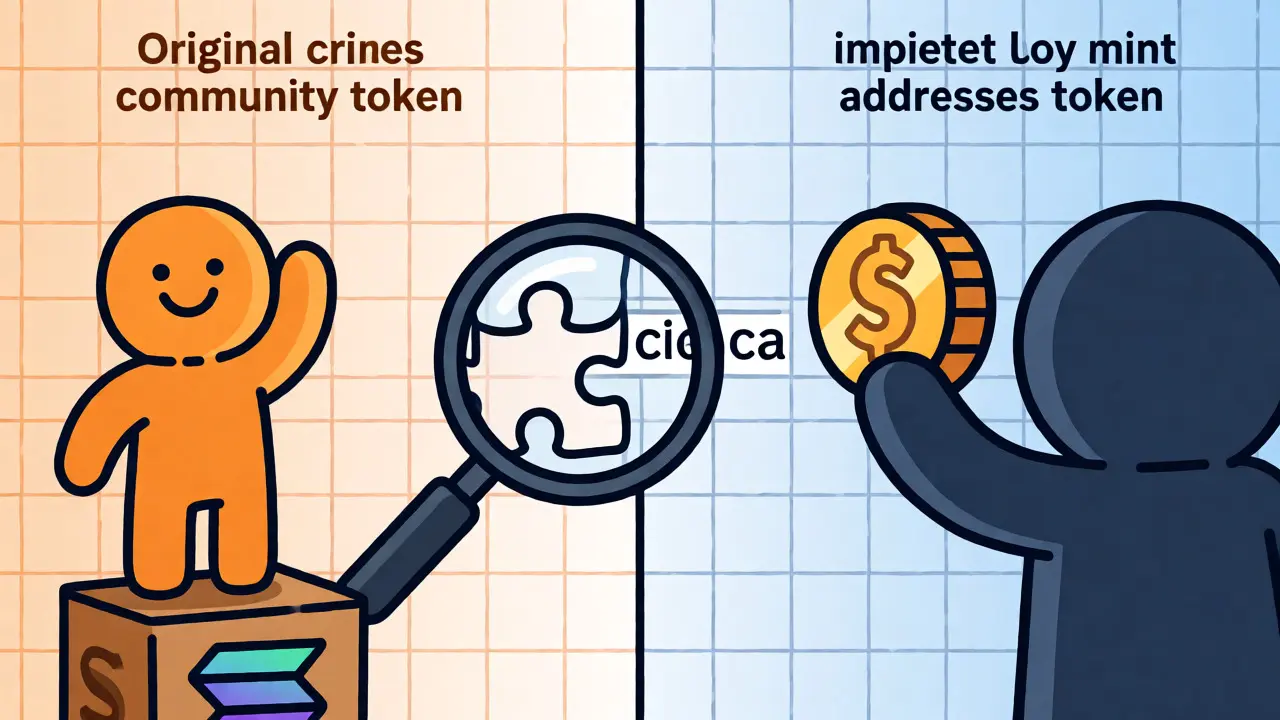
One of the biggest dangers in the memecoin space is ticker confusion. Searching for "COOK" will bring up multiple results. You might see a token associated with Tim Cook (Apple CEO) or other unrelated projects. Even within the "Let Him Cook" niche, there are competing claims.
In late 2024, a popular TikTok creator known as Vexbolts claimed ownership of the "let him cook" meme and launched his own token with a different contract address. This created a split in the community. Some traders believe Vexbolts’ token is the authentic one, while others stick with the original $COOK token that existed before his claim. Both tokens exist on-chain, but they are separate assets with different liquidity pools and communities.
To avoid buying the wrong asset, you must verify the contract address. The widely recognized community token uses the Solana mint address starting with G8Vy25.... Never rely solely on the ticker symbol "COOK" when making a purchase. Copy-paste the exact address from a trusted aggregator like CoinGecko or CoinMarketCap, and double-check it against DEX Screener.
How to Buy and Hold $COOK
If you decide to take the gamble, here’s the practical path to acquiring $COOK. Since it’s not listed on major centralized exchanges like Coinbase or Binance, you’ll need to use decentralized finance (DeFi) tools.
- Set Up a Wallet: Install a Solana-compatible wallet like Phantom or Solflare. Secure your seed phrase offline.
- Fund Your Wallet: Buy SOL (Solana’s native currency) from an exchange and send it to your wallet. You’ll need SOL for both the trade and network fees.
- Find the Pool: Go to a decentralized exchange interface like Jupiter Aggregator or Raydium. Paste the verified $COOK contract address to filter out imposters.
- Execute the Swap: Select the amount of SOL you want to spend. Be mindful of slippage settings; for low-liquidity coins, setting slippage too low may cause the transaction to fail, while setting it too high may result in a bad entry price.
- Monitor Your Position: Add the token to your wallet manually if it doesn’t appear automatically. Use DEX Screener to track real-time price movements and volume.
Remember, blockchain transactions are irreversible. If you send funds to the wrong address or lose your private keys, there is no customer support line to call. Treat every dollar you put into $COOK as money you are willing to lose completely.
Is It Worth the Risk?
Evaluating $COOK requires a shift in mindset. You aren’t investing in technology; you’re speculating on social sentiment. The token’s value depends entirely on whether the "let him cook" meme stays relevant in pop culture. If the phrase falls out of favor, the community may disperse, leaving holders with illiquid assets.
There are no fundamental metrics like P/E ratios or revenue streams to analyze. Instead, watch social indicators: Telegram activity, X engagement, and new holder growth. If these metrics stall, the price usually follows. For now, $COOK serves as a case study in how quickly internet culture can be monetized-and how fragile those monetizations can be.
What is the contract address for LET HIM COOK (COOK)?
The primary community token uses the Solana mint address G8Vy25NzjRmuQtnN35xF7j3X2Z1TrV39xijzu8Mg4w8n. Always verify this address on Solscan or DEX Screener before trading, as multiple tokens share the COOK ticker.
Does LET HIM COOK have any utility?
No, $COOK does not have inherent technical utility like staking, governance, or payment processing. It is a memecoin whose value derives from community engagement and the cultural relevance of the "let him cook" phrase.
Where can I buy COOK crypto?
You can buy $COOK on decentralized exchanges such as Raydium or through aggregators like Jupiter. It is generally not available on major centralized exchanges like Coinbase or Binance.
Is LET HIM COOK audited?
There is no record of a comprehensive, independent third-party audit for the $COOK smart contract. Users should rely on automated scanners like RugCheck to assess basic contract safety features.
Why are there different COOK tokens?
Ticker symbols on blockchains are not unique. Additionally, there has been controversy regarding the origin of the meme, leading to competing tokens, including one promoted by content creator Vexbolts, which has a different contract address.