What is MonkeDAO (DAOSOL) Crypto Coin? A Guide to Solana Liquid Staking
 Sep, 21 2026
You’re holding SOL in your wallet. It’s just sitting there, earning nothing while the network hums along. You know you should stake it, but running a validator node sounds like a nightmare of server racks and uptime alerts. Then someone mentions MonkeDAO. Suddenly, you see a token called DAOSOL a liquid staking derivative on the Solana blockchain that promises yield without the headache. But what exactly is this thing? Is it safe? And why does everyone in the Solana ecosystem seem obsessed with monkeys?
Let’s cut through the noise. MonkeDAO isn’t just another meme coin. It’s a governance layer wrapped around a financial tool, built specifically for the owners of the Solana Monkey Business (SMB) an NFT collection consisting of 5,000 unique digital assets. If you’ve ever wondered how a community can collectively manage millions of dollars in staked SOL, or if DAOSOL is worth your attention compared to giants like Marinade or Lido, you’re in the right place. We’ll break down the mechanics, the risks, and the actual utility, so you can decide if joining the tribe makes sense for your portfolio.
The Core Concept: Governance Meets Yield
At its heart, MonkeDAO is a decentralized autonomous organization focused on liquid staking and community governance operates on two distinct but connected tracks. First, it manages the treasury and direction of the SMB NFT project. Second, it provides a way for anyone-not just NFT holders-to stake their Solana (SOL) and earn rewards. The bridge between these two worlds is the $MONKE the native governance token used for voting rights within the DAO token and the daoSOL a liquid staking token representing staked SOL asset.
Think of it this way: When you stake SOL directly with a validator, your tokens are locked up. You can’t sell them, lend them, or use them as collateral until you unstake. That’s inefficient. MonkeDAO solves this by issuing daoSOL. When you deposit SOL into their pool, they mint daoSOL for you. This daoSOL grows in value relative to SOL as staking rewards accrue. You can trade that daoSOL instantly on exchanges, use it in DeFi protocols, or hold it. Meanwhile, the underlying SOL is working hard, earning roughly 6-7% annual percentage yield (APY), depending on network conditions.
Who controls where that SOL goes? That’s where the DAO part comes in. Holders of the $MONKE token vote on which validators receive the staked funds. This isn’t just bureaucratic theater; it’s a strategic move to support decentralization. By directing funds to smaller, emerging validators rather than just the top-tier giants, MonkeDAO aims to keep the Solana network healthy and less centralized.
How DAOSOL Works Under the Hood
If you’ve used Ethereum before, you might recognize daoSOL as similar to stETH from Lido. It’s a liquid staking derivative. But here’s the specific mechanism on Solana: MonkeDAO uses a system called DAOPool a smart contract-based liquidity pool that aggregates user deposits for staking. When you send SOL to DAOPool, the protocol delegates those funds to various validators chosen by the community. As those validators earn block rewards, the ratio of SOL to daoSOL changes. You don’t get more daoSOL tokens; instead, each daoSOL token becomes worth slightly more SOL over time.
This design allows for seamless integration with other parts of the Solana DeFi ecosystem a decentralized finance sector built on the Solana blockchain known for high speed and low fees. For example, you can supply daoSOL to lending platforms like Kamino or Marginfi to borrow against it. Or, you can pair it with USDC on Raydium to provide liquidity. Because daoSOL is an SPL token (Solana Program Library standard), it behaves just like any other crypto asset in your wallet, such as Phantom or Solflare.
| Feature | MonkeDAO (daoSOL) | Marinade Finance (mSOL) | Lido (stSOL) |
|---|---|---|---|
| Primary Focus | Community & SMB Ecosystem | General Purpose / Max Yield | Institutional / Brand Trust |
| Validator Strategy | Supports small/new validators | Algorithmic delegation | Top-tier established validators |
| Governance Token | $MONKE | $MNDE | $LDO |
| NFT Integration | Deep (Tensor Marketplace) | Minimal | Minimal |
Notice the difference in strategy. While Marinade optimizes purely for yield and Lido leans on brand recognition, MonkeDAO explicitly prioritizes network decentralization. They actively seek out new validators who need stake to gain weight in the network. This creates a flywheel effect: the DAO supports new validators, those validators perform well, and the community gains influence over the network’s structure.
The Role of the $MONKE Token
Don’t confuse daoSOL with $MONKE. They serve different purposes. daoSOL is your yield-bearing asset. $MONKE is your voting power. If you want to have a say in how the treasury is spent, which partnerships are formed, or which validators are added to the rotation, you need $MONKE. These tokens are distributed to early contributors, SMB NFT holders, and sometimes through incentives.
Why would you buy $MONKE? Two main reasons. First, speculation. If the SMB brand grows, the demand for governance might rise. Second, utility. Some features within the MonkeDAO ecosystem, particularly access to exclusive drops or voting thresholds, require holding a certain amount of $MONKE. It’s the key to the clubhouse. However, unlike daoSOL, $MONKE doesn’t inherently generate yield from staking. Its value is driven by market sentiment and the perceived value of controlling the DAO.

Ecosystem Utilities: More Than Just Staking
MonkeDAO has expanded beyond simple staking. They’ve integrated with Tensor the leading NFT marketplace on Solana to create a specialized trading environment for SMB collections. This means better tools for traders, including analytics and loyalty programs powered by Interlace a platform providing loyalty and engagement solutions for Web3 communities.
For SMB holders, this creates a cohesive loop. You hold an SMB NFT. You stake SOL via MonkeDAO to earn daoSOL. You use that yield to potentially buy more NFTs or participate in ecosystem events. The global community, often referred to as "MonkeDAO chapters," organizes IRL meetups in over 28 cities, reinforcing the social aspect of the brand. In crypto, community retention is a strong indicator of longevity. Unlike many projects that fade after launch, MonkeDAO maintains active engagement through both digital governance and physical presence.
Risks and Realities: What Could Go Wrong?
No investment is risk-free, and MonkeDAO is no exception. Let’s look at the data. As of late 2025, DAOSOL trades at varying prices across trackers-CoinMarketCap might show ~$219, while Coinbase shows lower figures due to liquidity differences. This discrepancy highlights a key issue: liquidity fragmentation. Most trading volume occurs on Raydium, a decentralized exchange. If you’re used to buying on Binance or Coinbase, you might face slippage or wider spreads.
Another concern is regulatory ambiguity. DAOs exist in a legal gray area globally. While MonkeDAO operates transparently on-chain, future regulations could impact how governance tokens are classified. Additionally, relying on smaller validators introduces technical risk. If a delegated validator suffers downtime or slashing penalties, the yield for all daoSOL holders could dip temporarily. MonkeDAO mitigates this by spreading stake across multiple validators, but it’s not zero-risk.
Finally, consider the competition. Marinade Finance holds a larger market share in the liquid staking space. If MonkeDAO fails to innovate or maintain community interest, users might migrate to competitors offering higher yields or better integrations. The sub-$1 billion market cap indicates it’s still a niche player. Your success depends on whether you believe the SMB brand and community model will sustain growth against larger, generic staking providers.
How to Start Using MonkeDAO
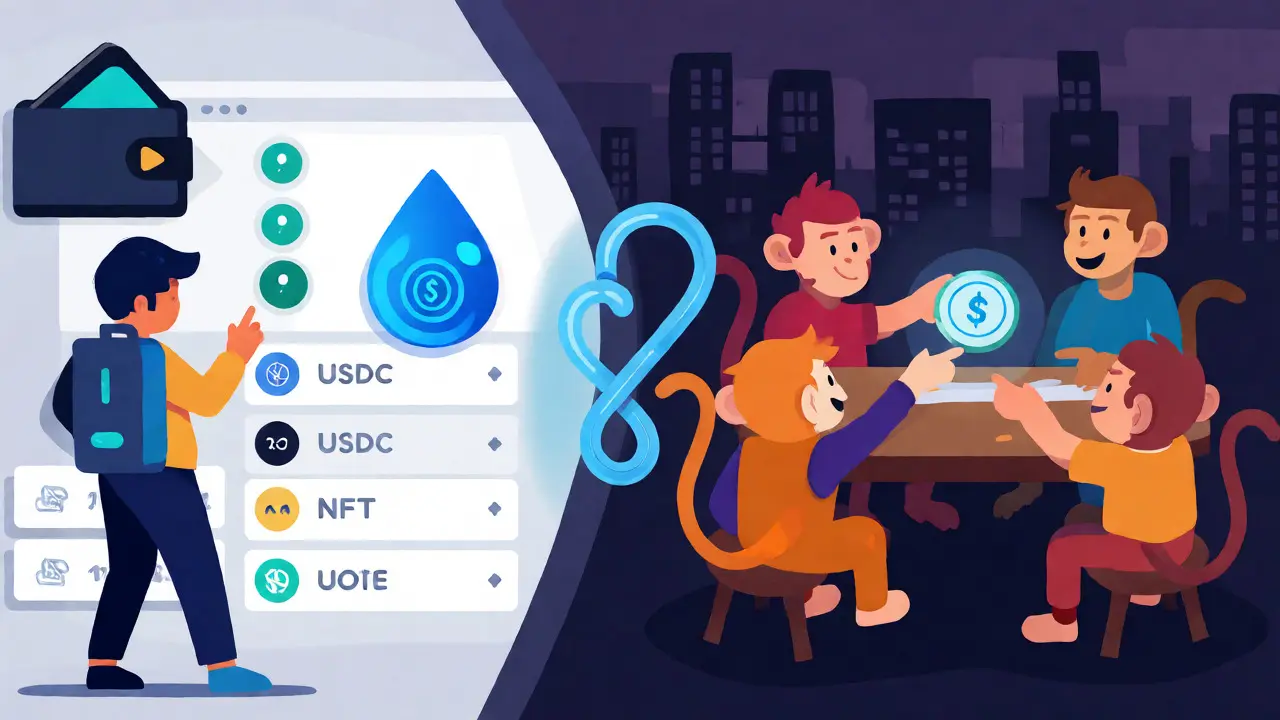
Ready to test the waters? Here’s the practical path:
- Get a Wallet: Download Phantom or Solflare. Ensure you have some SOL for transaction fees.
- Acquire SOL: Buy SOL on a major exchange and withdraw it to your wallet.
- Navigate to DAOPool: Visit the official MonkeDAO website and connect your wallet. Look for the "Stake" section.
- Deposit SOL: Enter the amount of SOL you wish to stake. Confirm the transaction. You will receive daoSOL in return.
- Monitor Rewards: Check your wallet periodically. You won’t see new tokens appear; instead, the conversion rate of daoSOL to SOL will increase.
- Unstake Anytime: When you want your original SOL back plus rewards, swap your daoSOL back to SOL on Raydium or through the DAO interface. Note that direct unstaking might involve a short delay, whereas swapping is instant.
Keep documentation handy. While the UI is improving, new users often find the flow confusing compared to one-click stakers. Community Discord channels are invaluable for troubleshooting specific errors.
Frequently Asked Questions
Is DAOSOL the same as the MONKE token?
No. DAOSOL is a liquid staking token that represents staked SOL and earns yield. MONKE is the governance token used for voting on DAO proposals. They are separate assets with different utilities and value drivers.
Do I need to own an SMB NFT to use MonkeDAO?
No, you do not need to own an SMB NFT to stake SOL and earn daoSOL. Anyone can use the DAOPool service. However, owning an SMB NFT may grant you additional benefits, such as boosted rewards or exclusive access to community events.
Where can I buy DAOSOL?
The primary venue for DAOSOL trading is Raydium, a decentralized exchange on Solana. Some centralized exchanges may list it, but liquidity is often thinner there compared to Raydium. Always check current volume and spread before executing large trades.
What happens if a validator gets slashed?
If a validator delegated by MonkeDAO experiences slashing (penalties for downtime or double-signing), the total amount of SOL in the pool decreases slightly. This reduces the backing value of daoSOL. MonkeDAO mitigates this by diversifying stake across multiple validators, minimizing the impact of any single failure.
Can I use DAOSOL in other DeFi protocols?
Yes, because DAOSOL is an SPL token, it is compatible with most Solana DeFi protocols. You can supply it to lending markets like Kamino, use it as collateral, or pair it in liquidity pools on DEXs like Raydium or Orca.
John Morgan
September 21, 2026 AT 13:17Another overhyped NFT side project trying to sell you liquid staking like it's some revolutionary breakthrough. Marinade and Lido have been doing this for years with actual institutional backing while MonkeDAO is just riding the coattails of a monkey picture collection. If you want decentralization go buy SOL and run your own node or use a reputable provider don't put your hard-earned dollars into a DAO that probably has half its treasury tied up in illiquid NFT floor prices. This whole ecosystem feels like a closed loop designed to keep money circulating among insiders rather than providing real utility to the broader market.
dillon wright
September 22, 2026 AT 08:12I get where you're coming from with the skepticism but I think we might be missing the bigger picture here about community alignment
The thing that actually drew me to MonkeDAO wasn't just the yield which yeah is comparable to other providers but the fact that they actively direct stake toward smaller validators instead of just chasing the highest APY at all costs That approach feels more aligned with what Solana was originally supposed to be about before everything got so centralized around a few big players
Plus having an active governance token means regular users can actually vote on treasury allocations which is rare enough in crypto these days without feeling like a puppet show The SMB integration adds another layer too because it creates a reason for people to hold the asset beyond just speculative trading which helps stabilize the ecosystem long term
Matthew Alunni
September 22, 2026 AT 15:15We must consider the ethical implications of prioritizing algorithmic yield over human-centric governance structures when evaluating any decentralized protocol
True decentralization requires sacrifice and a willingness to accept slightly lower returns in exchange for network resilience and equitable distribution of power among participants who understand the philosophical weight of their decisions
If we continue to treat blockchain technology merely as a casino for maximizing short-term gains then we fail to realize its potential as a tool for collective self-determination and moral agency within digital economies
The choice between MonkeDAO and larger competitors is not just financial but ideological reflecting whether one values community cohesion or pure efficiency above all else in our increasingly fragmented society
Those who dismiss such initiatives often lack the patience required to build meaningful institutions that endure beyond transient market cycles and hype-driven speculation
Ultimately every transaction is a vote for the kind of world we wish to inhabit one where cooperation outweighs competition in the pursuit of shared prosperity
We cannot ignore the historical precedent of failed collectives that lacked clear purpose or engaged members leading to stagnation and eventual irrelevance in fast-moving technological landscapes
Therefore supporting projects that emphasize education engagement and transparent decision-making processes becomes a civic duty for those who believe in democratic principles applied to new media
Let us not be swayed by superficial metrics alone but look deeper into the social fabric woven by these protocols through daily interactions and shared goals
In time perhaps we will see that the true value lies not in the token price but in the strength of relationships formed across borders through common vision and mutual respect
This perspective challenges us to rethink our assumptions about success in digital spaces where intangible assets hold profound significance for future generations seeking autonomy
Only through mindful participation can we ensure that technology serves humanity rather than enslaving it to invisible algorithms driven solely by profit motives
The journey toward true freedom demands courage to choose paths less traveled even if they appear riskier at first glance to conventional wisdom
May we remain vigilant guardians of liberty ensuring no single entity dominates the landscape at the expense of diversity and innovation
Such contemplation reveals the interconnectedness of economic choices with broader existential questions facing modern civilization today
Thus let each action taken within this sphere reflect a commitment to justice fairness and enduring legacy rather than fleeting satisfaction
Mark Riquelme
September 23, 2026 AT 17:55To add some technical clarity regarding the validator selection process mentioned earlier MonkeDAO employs a weighted delegation strategy that factors in both performance history and geographic distribution
This ensures that stake is not concentrated in data centers prone to regional outages which significantly reduces systemic risk compared to purely algorithmic approaches used by some competitors
Furthermore the smart contract architecture allows for rapid rebalancing in response to slashing events minimizing downtime impact on daoSOL holders
It is also worth noting that the liquidity depth on Raydium has improved substantially over the past quarter making entry and exit positions much more efficient for mid-sized traders
For those concerned about regulatory compliance the DAO structure operates under Wyoming LLC laws providing a clearer legal framework than many offshore alternatives
This combination of technical robustness and legal transparency makes it a compelling option for serious investors looking beyond meme narratives
Always verify current APY figures directly from the dashboard as network conditions fluctuate frequently affecting net yields
Proper due diligence remains essential regardless of community enthusiasm surrounding any particular project
Thank you for highlighting these nuances which help distinguish substantive infrastructure from mere marketing fluff
Best regards to all participating in this evolving ecosystem
Alan Farley
September 23, 2026 AT 21:05Love seeing this level of discussion happening here! It really shows how much the community cares about understanding the mechanics behind the scenes rather than just blindly following trends
I've personally found the Discord support team incredibly helpful when I had issues with my initial stake conversion which speaks volumes about their commitment to user experience
Can't wait to see what partnerships they announce next year especially given the growing interest in Solana-based DeFi integrations worldwide
Keep up the great work everyone involved in building this space together!