What is NEO (NEO) Crypto? A Guide to China's Ethereum
 Oct, 11 2026
You've probably heard of Bitcoin and maybe even Ethereum. But if you're digging into the altcoin trenches, you'll eventually hit a wall called NEO. Often dubbed "China's Ethereum," it’s not just another copycat project. It has its own unique mechanics, a dual-token economy, and a history that goes back further than most people realize.
So, what exactly is NEO? Why does it have two tokens instead of one? And more importantly, does it still matter in 2026 when the crypto landscape looks nothing like it did in 2017? Let's break it down without the jargon overload.
The Origins: From Antshares to NEO
To understand where NEO is going, you need to know where it started. The project wasn't always called NEO. In 2014, co-founders Da Hongfei and Erik Zhang launched it as Antshares. Yes, really. They wanted to build a platform for digitizing real-world assets using smart contracts, but the name didn't stick.
In 2017, they rebranded to NEO. This wasn't just a marketing trick; it signaled a shift toward a broader vision of a "smart economy." Erik Zhang, the technical brain behind the operation, invented the Delegated Byzantine Fault Tolerance (dBFT) consensus mechanism. This made NEO the first cryptocurrency to use this specific algorithm, which differs significantly from the Proof-of-Work model used by Bitcoin or the Proof-of-Stake models emerging elsewhere.
| Feature | Detail |
|---|---|
| Launch Year | 2014 (as Antshares), Rebranded 2017 |
| Founders | Da Hongfei, Erik Zhang |
| Consensus Mechanism | Delegated Byzantine Fault Tolerance (dBFT) |
| Max Supply (NEO) | 100,000,000 tokens |
| Secondary Token | GAS (used for fees and computation) |
| Programming Languages | C#, Java, Python, Go, Kotlin |
The Dual-Token System: NEO vs. GAS
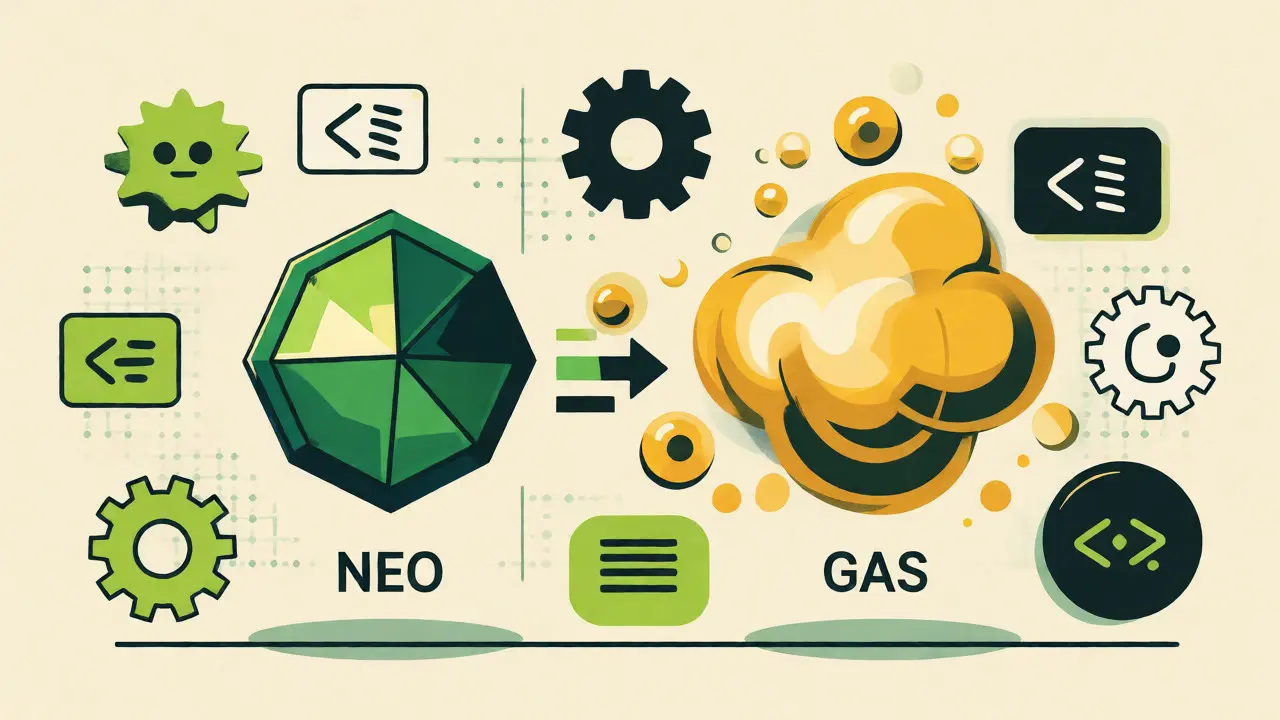
This is where things get interesting-and slightly confusing for newcomers. Most blockchains have one native token. NEO has two: NEO and GAS.
Think of NEO as shares in a company. If you hold NEO, you own part of the network. You can vote on governance decisions, and crucially, holding NEO earns you GAS. You don't buy GAS directly with fiat currency usually; you earn it by holding NEO. GAS is the fuel. When you run a smart contract or send a transaction, you pay in GAS. This separation aims to decouple the investment value (NEO) from the operational cost (GAS).
Here’s how the supply works:
- NEO Supply: Fixed at 100 million. These were pre-mined. There are no new NEO coins being created. The smallest unit is 1 NEO-you can't send half a NEO.
- GAS Supply: Also capped at 100 million, but these are generated over time through a decay algorithm. This process takes about 22 years to complete.
Why split them? The idea is stability. If gas prices spike due to network congestion, it doesn't necessarily crash the price of your ownership stake (NEO). It’s a clever design choice intended to make the network more predictable for developers and users alike.
Technology: dBFT and NeoVM
If you're a developer, or just curious under the hood, NEO stands out because of its tech stack. First, there's the consensus. dBFT allows the network to reach agreement quickly and safely, preventing forks and ensuring finality. Unlike Bitcoin, where transactions might be reversed during a chain reorganization, once a transaction is confirmed on NEO, it's done. This makes it attractive for financial applications where certainty matters.
Then there's the NeoVM (Neo Virtual Machine). This is the engine that runs smart contracts. What makes NeoVM special is its lightweight nature and high concurrency. It handles thousands of transactions per second-reportedly up to 3,000 TPS-which is miles ahead of early Ethereum versions.
But the real selling point for devs? Language support. On Ethereum, you mostly learn Solidity. On NEO, you can write smart contracts in languages you already know: C#, Java, Python, Go, and Kotlin. This lowers the barrier to entry massively. If you're a .NET developer, you don't need to learn a new language to build dApps on NEO. That accessibility helped NEO attract a robust developer community early on.
Use Cases: Smart Economy and Digital Identity
NEO isn't just trying to be a faster payment rail. Its core mission is the "Smart Economy." This involves three pillars:
- Digital Assets: Turning physical things (like property titles, stocks, or bonds) into digital tokens on the blockchain. These tokens are legally recognized, meaning they have real-world legal backing.
- Digital Identity: Creating verifiable identities for individuals and corporations. Imagine logging into services without passwords, using your blockchain identity instead.
- Smart Contracts: Automating agreements. If X happens, then Y executes automatically. No lawyers needed for simple transfers.
A major partnership here is with Microsoft. Since 2017, Microsoft has been involved with NEO, providing infrastructure and credibility. This corporate backing distinguishes NEO from many purely decentralized projects that struggle with enterprise adoption.
Market Performance and Investment Potential
Let's talk numbers, because let's face it, that's why most people look at NEO. In 2018, during the previous bull run, NEO hit an all-time high of $196. Fast forward to late 2026, and the price has settled much lower, hovering around $11. This drop reflects the broader market corrections and increased competition from newer Layer 1 blockchains like Solana and Avalanche.
However, analysts remain divided. Some predict modest growth, seeing NEO stabilizing around $12-$15 in the near term. Others are bullish long-term, projecting potential returns if the platform captures significant institutional interest in asset tokenization. The key risk? Competition. While NEO was an early mover, it faces stiff pressure from ecosystems with larger DeFi (Decentralized Finance) footprints.
Liquidity remains strong. As a top-tier cryptocurrency, NEO trades on all major exchanges. You can buy it easily via Coinbase, Binance, or Kraken. Staking is also straightforward: hold NEO in a compatible wallet, and you accrue GAS automatically. Just remember, you need to claim that GAS periodically; it doesn't appear in your balance instantly.

Pros and Cons: Is NEO Right for You?
No crypto is perfect. Here’s the honest breakdown:
Pros:
- Developer Friendly: Support for mainstream languages is a huge win.
- Fast Finality: dBFT ensures transactions don't get reversed.
- Legal Framework: Focus on regulated digital assets appeals to traditional finance.
- Low Volatility for Owners: Holding NEO gives you yield (GAS) without active trading.
Cons:
- Complexity: The two-token system confuses beginners.
- Centralization Concerns: Top addresses hold a large chunk of supply. Critics argue it's less decentralized than Bitcoin.
- Competition: Newer chains offer better tooling and community hype.
- Geopolitical Risk: Regulatory shifts in China can impact sentiment, despite the project's global nature now.
How to Buy and Store NEO
If you decide to jump in, here’s the quick path. First, choose an exchange. Binance and Coinbase are reliable options. Create an account, verify your ID, and deposit funds. Search for NEO/USDT or NEO/BTC pairs. Buy your NEO.
Now, storage. Don't leave large amounts on an exchange. Use a hardware wallet like Ledger or Trezor, which supports NEO. Alternatively, software wallets like O3 Wallet or Neon Wallet work well. Remember, your NEO holdings generate GAS. You’ll need to manage both. Keep your private keys safe-lose those, and you lose everything.
Staking is passive. You don't need to lock up your NEO for a set period like some other PoS chains. You just hold it. Claim your GAS rewards every few months to avoid losing unclaimed balances after certain protocol updates.
The Future Outlook
Where does NEO go from here? The focus is shifting heavily toward interoperability and cross-chain functionality. The team is working on solutions that allow NEO to communicate seamlessly with other blockchains, reducing isolation. Additionally, the push for real-world asset (RWA) tokenization aligns perfectly with current trends in TradFi (Traditional Finance).
If banks start putting bonds or real estate deeds on-chain, platforms like NEO-with their emphasis on digital identity and legal compliance-are well-positioned to capture that market share. It’s not a race to be the fastest meme coin; it’s a marathon to be the most trusted infrastructure layer.
What is the difference between NEO and GAS?
NEO represents ownership of the network and grants voting rights. GAS is the utility token used to pay for transaction fees and smart contract execution. Holding NEO generates GAS as a reward.
Is NEO still considered "China's Ethereum"?
While the nickname persists, NEO has evolved beyond just being an Ethereum clone. It differentiates itself through its dBFT consensus, multi-language smart contract support, and focus on digital identity and asset regulation.
Can I mine NEO?
No, NEO cannot be mined. All 100 million NEO tokens were pre-mined at launch. You acquire NEO by purchasing it on exchanges or earning it through staking rewards (in GAS).
Which wallets support NEO?
Popular options include hardware wallets like Ledger Nano S/X and Trezor Model T. Software wallets such as O3 Wallet, Neon Wallet, and Atomic Wallet also provide secure storage for NEO and GAS.
What programming languages does NEO support?
NEO supports C#, Java, Python, Go, and Kotlin. This allows developers to build smart contracts using familiar languages rather than learning specialized ones like Solidity.