What is PiP (Hyperliquid)? PIP Crypto Token Guide, Price & Risks
 May, 28 2026
Quick Summary: Key Takeaways
- PiP (PIP) is the official mascot and community meme token of the Hyperliquid high-performance Layer-1 blockchain for perpetual futures trading ecosystem.
- It has no core utility like governance or staking; its value is driven purely by speculation, branding, and community sentiment.
- As of late 2025/early 2026, PIP trades around $3.88, down over 95% from its all-time high of $81.03 in December 2024.
- You cannot buy PIP on centralized exchanges like Binance Spot. You must use a Web3 wallet and swap on a decentralized exchange (DEX) within the Hyperliquid network.
- The token has a fixed maximum supply of 1,000,000, with approximately 786,090 currently in circulation, resulting in a small market cap of roughly $3 million.
What Exactly Is PiP (Hyperliquid)?
If you are scrolling through the assets on the Hyperliquid HL chain, you will eventually bump into PiP. It carries the ticker symbol PIP. Unlike the native HYPE the primary utility and gas token of the Hyperliquid blockchain token, which powers the network’s transactions and fees, PiP does not have a technical job to do. Instead, it serves as the “liquid mascot” of the Hyperliquid ecosystem.
In the world of crypto, mascot tokens are essentially digital inside jokes or brand ambassadors. They thrive on community energy rather than code. PiP is categorized as a low-cap meme coin. This means its price movements are heavily influenced by social media trends, trader enthusiasm, and general market speculation rather than fundamental protocol upgrades or revenue generation. It sits alongside other niche community tokens on the chain, such as YEETI and LIQD, forming a cultural layer on top of the serious financial infrastructure that Hyperliquid provides.
Understanding PiP requires separating it from the main platform. Hyperliquid is a powerhouse for decentralized derivatives trading, handling billions in volume. PiP is just a small character living in that universe. While the platform grows, PiP might see interest simply because people recognize the name, but it does not grant you any special rights, discounts, or voting power within the Hyper Foundation.
Tokenomics: Supply and Scarcity
When evaluating any cryptocurrency, looking at the numbers behind the scenes is crucial. PiP operates with a very tight supply model compared to massive meme coins like Dogecoin or Shiba Inu. Here is the breakdown:
- Maximum Supply: 1,000,000 PIP. This number is hard-coded and will never increase. There is no inflation mechanism pumping new tokens into existence.
- Circulating Supply: Approximately 786,090 PIP. This means nearly 79% of all possible tokens are already out there being traded or held in wallets.
- Fully Diluted Valuation (FDV): At a price of $3.88 per token, if every single one of the 1 million tokens were in circulation, the total value would be about $3.88 million.
This scarcity narrative is often used by proponents to argue for potential upside. Because the supply is capped at a mere million units, some traders view it as deflationary by nature. However, scarcity alone does not create demand. Without a burning mechanism or buyback program documented in public roadmaps, the price depends entirely on whether more people want to buy PIP than sell it at any given moment.
Price History and Volatility Reality Check
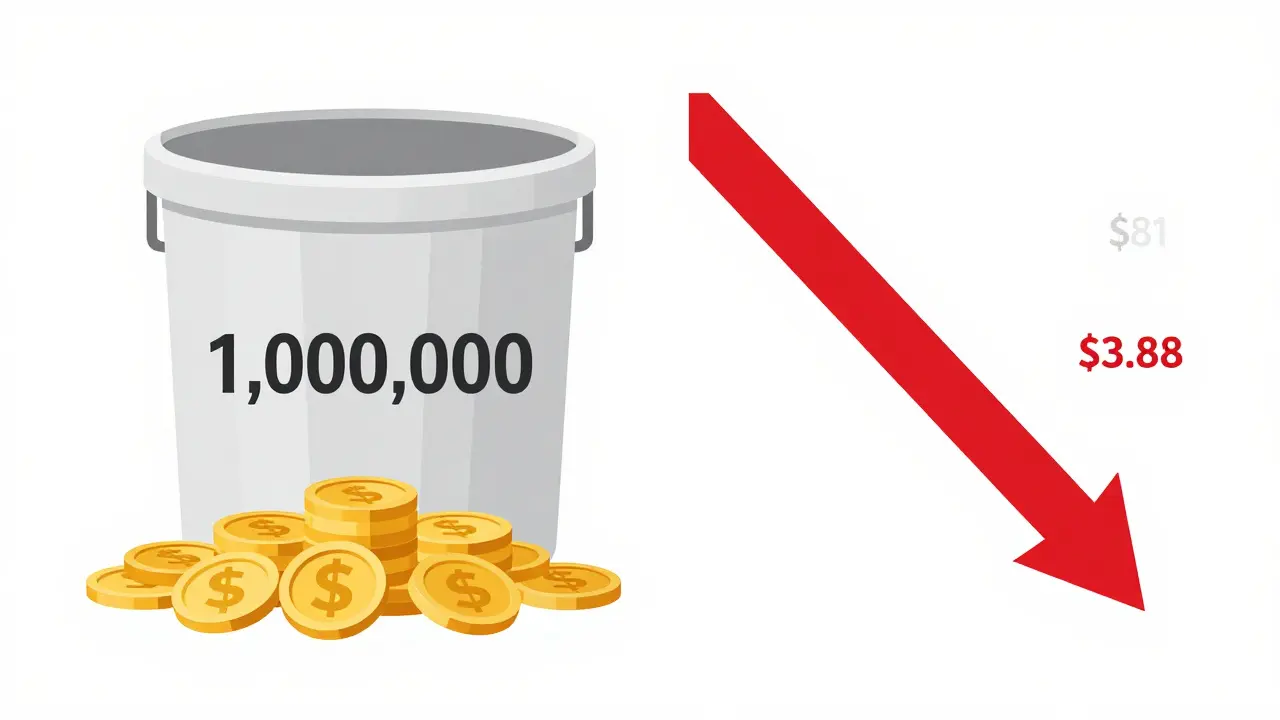
Let’s talk about the money. If you bought PiP at its peak, you are likely sitting on significant unrealized losses. The token hit an All-Time High (ATH) of $81.03 on December 17, 2024. That was a moment of extreme hype. Since then, the price has retraced dramatically.
By late 2025 and heading into 2026, PiP stabilized in the $3.80-$4.00 range. This represents a drop of over 95% from its highest point. For context, a 95% drawdown is typical for speculative meme tokens during bear markets or post-hype cooling periods. The current market capitalization hovers around $3.05 million.
Why did it crash? Meme coins run on attention. When the initial excitement faded, liquidity dried up. The daily trading volume for PiP is surprisingly thin, often ranging between $5,500 and $6,000. Compare this to major cryptocurrencies that trade hundreds of millions daily. Low volume means two things: first, it is hard to move large amounts of money without affecting the price (slippage); second, the market is highly susceptible to manipulation by large holders (whales).
| Feature | PiP (Hyperliquid) | Dogecoin (DOGE) | Shiba Inu (SHIB) |
|---|---|---|---|
| Market Cap | ~$3 Million | ~$20+ Billion | ~$5+ Billion |
| Daily Volume | ~$5,500 | ~$500+ Million | ~$200+ Million |
| Supply Type | Fixed (1M Max) | Inflationary | Deflationary (Burns) |
| Liquidity Risk | Very High | Low | Low |
The table above illustrates the scale difference. PiP is a micro-cap asset. Investing here is akin to buying shares in a startup before it has proven its business model, except with even less regulatory protection and higher volatility.
How to Buy PiP (PIP) on Hyperliquid
You won’t find PiP listed on the spot markets of major centralized exchanges like Coinbase, Kraken, or the standard Binance interface. Crypto.com tracks its price but explicitly states it is “not tradable yet” on their platform. To get your hands on PIP, you need to enter the world of Web3.
- Set Up a Web3 Wallet: You need a wallet that supports the Hyperliquid chain. The Binance Web3 Wallet a non-custodial wallet integrated into the Binance app is a popular entry point recommended by guides. Alternatively, you can use MetaMask if you configure it for the Hyperliquid network parameters.
- Fund Your Wallet: You cannot buy PIP directly with USD. You need a base asset that exists on Hyperliquid. Typically, this is HYPE (the native token) or a stablecoin like USDC bridged to the chain. If you hold these on another network, you may need to use a bridge service to transfer them to Hyperliquid L1.
- Connect to a DEX: Navigate to a decentralized exchange operating on Hyperliquid. These platforms allow peer-to-peer swapping without an intermediary company holding your funds.
- Swap for PIP: Find the trading pair, usually HYPE/PIP or USDC/PIP. Enter the amount you wish to spend. Be careful with slippage settings; due to low liquidity, you might need to set a wider slippage tolerance (e.g., 5-10%) to ensure the transaction goes through, though this increases the risk of getting a worse price.
Remember, once you swap, the tokens are in your private wallet. You are responsible for securing your seed phrase. If you lose access, there is no customer support team to call.
Risks and Considerations Before Buying
Before you commit capital to PiP, it is vital to understand what you are signing up for. This is not a passive investment like a bond or a blue-chip stock. It is a high-risk speculative play.
- Lack of Utility: PiP does not earn revenue. It does not govern the network. It does not reduce trading fees. Its only purpose is to exist as a brand symbol. If the community loses interest, the token has no floor price supported by fundamentals.
- Liquidity Traps: With daily volumes under $6,000, selling a large position can crash the price. If you try to sell 10,000 PIP at once, you might deplete the available buy orders, causing your average exit price to plummet. This is known as slippage risk.
- Concentration Risk: With only ~786,000 tokens circulating, it is easy for a few wallets to hold a significant percentage of the supply. If one of these “whales” decides to sell, the price impact is immediate and severe.
- Regulatory Uncertainty: As a meme token traded via DeFi, PiP falls into a gray area regarding securities laws. While regulators have not targeted PiP specifically, the broader crackdown on unregistered tokens could affect accessibility or perception.
Furthermore, there is no official roadmap for PiP. No planned burns, no upcoming partnerships, and no integration features are publicly documented. Its future is tied strictly to the cultural relevance it maintains within the Hyperliquid community. If Hyperliquid continues to grow as a leading derivatives platform, PiP may benefit from increased visibility. But if the ecosystem shifts focus solely to institutional-grade tools, mascot tokens could be left behind.
Is PiP a Good Investment?
That depends entirely on your risk tolerance and goals. If you are looking for long-term store of value or steady growth, PiP is likely not suitable. It lacks the structural drivers that sustain prices over years. It is a vehicle for short-term speculation.
However, if you are deeply embedded in the Hyperliquid community, enjoy the culture, and want to bet on the continued rise of the ecosystem’s brand identity, a small allocation might make sense. Treat it like entertainment spending-money you are fully prepared to lose completely. Never invest rent money or emergency funds into micro-cap meme tokens. The 95% drop from its ATH is a stark reminder that these assets can vanish in value quickly when the hype cycle turns.
What is the difference between HYPE and PIP on Hyperliquid?
HYPE is the native utility token of the Hyperliquid blockchain. It is used to pay for gas fees, secure the network, and potentially for governance. PIP is a community mascot token with no technical utility. HYPE drives the economy; PIP reflects the culture.
Can I buy PiP on Binance Centralized Exchange?
No. You cannot buy PIP on the standard Binance spot or futures markets. You must use the Binance Web3 Wallet feature to connect to a decentralized exchange (DEX) on the Hyperliquid network to swap for PIP.
Does PiP have a maximum supply?
Yes, PiP has a fixed maximum supply of 1,000,000 tokens. Approximately 786,090 are currently in circulation, meaning no new tokens will ever be minted.
Why did PiP drop 95% from its all-time high?
Like many meme coins, PiP experienced a hype cycle in late 2024, reaching $81.03. As speculative interest waned and liquidity decreased, the price corrected sharply to its current range of ~$3.88. This volatility is typical for low-cap tokens without fundamental utility.
Is PiP a safe investment?
PiP is considered a high-risk investment. It has low liquidity, no underlying utility, and extreme price volatility. It should only be purchased with capital you can afford to lose entirely.
Where can I track the price of PiP?
You can track PiP on major aggregators like CoinMarketCap and CryptoRank. Note that prices may vary slightly between platforms due to different data sources and liquidity pools on various DEXs.