What is Pugg (PUGG) Crypto? A Deep Dive into the Solana Meme Token
 Sep, 6 2026
You might have seen the ticker PUGG flash across your screen and wondered if it’s the next big thing or just another fleeting internet joke. It’s a fair question. In the chaotic world of cryptocurrency, new tokens pop up daily, promising moonshots and utility that rarely materialize. Pugg (PUGG) is one such asset. It’s not trying to solve complex financial problems or revolutionize banking. Instead, it leans heavily into its identity as a community-driven meme token on the Solana blockchain. If you’re looking for serious tech innovation here, you’ll be disappointed. But if you’re curious about the mechanics of micro-cap speculation and the "Pepe" ecosystem, this breakdown explains exactly what Pugg is, how it works, and why it matters-or doesn’t.
The Core Identity: What Exactly Is Pugg?
Pugg is defined by its creators and trackers like CoinGecko as a community-driven meme token launched on the Solana blockchain. It positions itself explicitly within the "Pepe family," acting as a humorous derivative of the wildly popular PEPE token. The branding isn’t subtle; CoinMarketCap describes it with provocative language, calling it "the forgotten, retarded friend of Pepe." This self-deprecating humor is central to its appeal. Unlike utility tokens that promise staking rewards or governance rights, Pugg’s primary function is social cohesion and speculative trading. It thrives on the culture of internet memes rather than technological breakthroughs.
Because it lives on Solana a high-performance blockchain known for low transaction fees and fast processing times, Pugg benefits from the network’s infrastructure. Solana uses the SPL token standard, meaning PUGG is likely a standard fungible token contract. There is no custom blockchain or novel consensus mechanism behind it. It’s a simple digital asset riding the wave of Solana’s popularity among retail traders who prefer cheap swaps over Ethereum’s gas fees.
Tokenomics and Supply Details
Understanding the numbers is crucial when dealing with micro-cap assets. According to data from CoinMarketCap and CoinGecko, Pugg has a total and maximum supply of approximately 999.99 million PUGG tokens, which is effectively rounded to 1 billion in some reports. Crucially, the circulating supply matches the total supply. This means there are no locked tokens for the team or investors waiting to dump on the market later. Every single token exists in the wild right now.
However, the holder count tells a different story. As of recent snapshots, only around 625 addresses hold PUGG tokens, indicating a very small and niche community base. Compare this to major cryptocurrencies with millions of holders, and you see how fragile this ecosystem is. With so few participants, large trades can significantly impact the price, leading to extreme volatility.
Price History and Market Performance
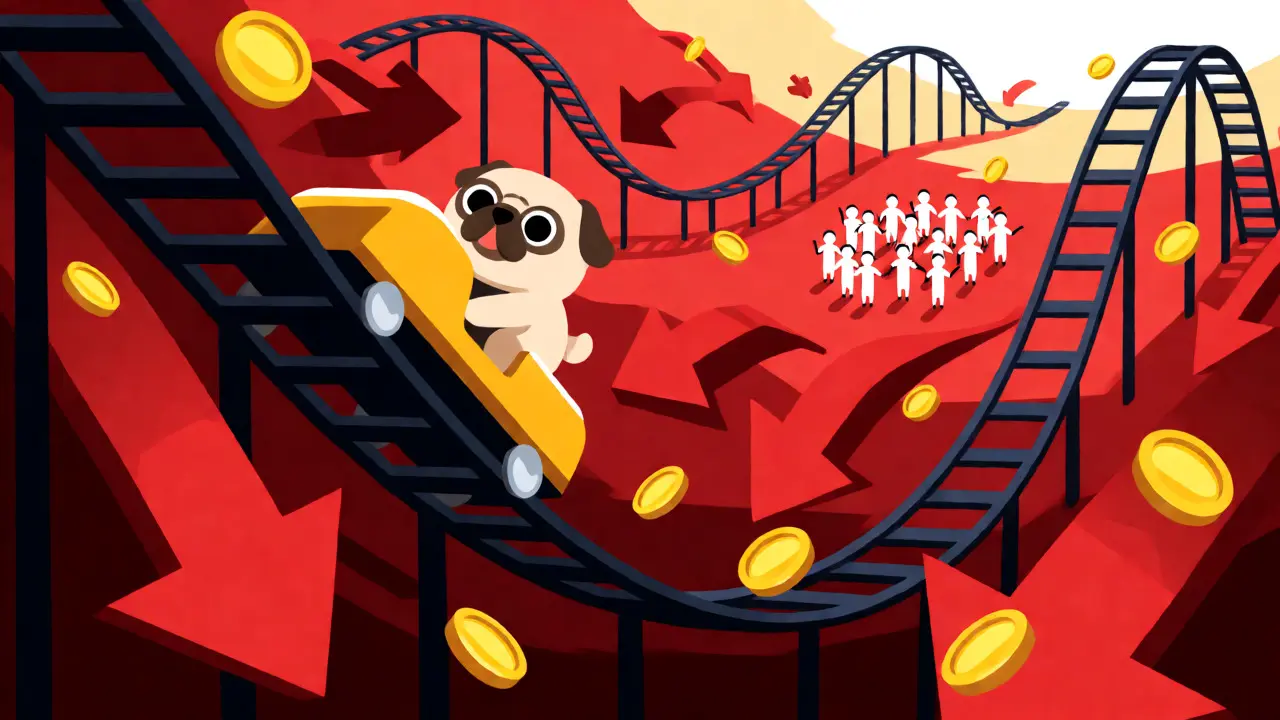
If you’re hoping for steady growth, look elsewhere. Pugg’s price history is a rollercoaster typical of meme coins. It reached an all-time high (ATH) of $0.002767 USD on April 25, 2025. Since then, it has suffered a massive drawdown, falling over 99% from that peak. At the time of recent data collection, the price hovered around $0.00001351 USD. This near-total collapse from its ATH highlights the speculative nature of the asset. It’s not an investment vehicle for long-term holding unless you believe in a massive cultural resurgence of the specific meme.
Market capitalization reflects this tiny scale. Pugg sits at roughly $13,500 USD, ranking it deep in the thousands among cryptocurrencies-around #7,589 on CoinMarketCap and #9,470 on LiveCoinWatch. These rankings aren’t just numbers; they signal liquidity risks. A market cap this low means that even modest sell orders can crash the price, while small buys can send it soaring temporarily.
| Metric | Value | Context |
|---|---|---|
| Ticker | PUGG | Differentiate from PUG (Pug Coin) |
| Blockchain | Solana | Uses SPL token standard |
| Total Supply | ~1 Billion | 100% Circulating |
| Market Cap | ~$13,500 | Micro/Nano-cap category |
| All-Time High | $0.002767 | Achieved April 2025 |
| Holders | ~625 | Extremely low adoption |
Pugg vs. Other "Pug" Tokens: Avoiding Confusion
One of the biggest pitfalls for new buyers is ticker confusion. You might search for "Pug" and find several different coins. Here is how Pugg differs from its namesakes:
- Pugg (PUGG): The subject of this article. A Solana-based meme token associated with the Pepe family. No utility, purely speculative.
- Pug Coin (PUG): Often confused with Pugg. This token claims to support pug charities and has a roadmap involving NFT games like "Pug Royale." It operates on a different chain and has a vastly different supply structure (100 trillion max supply).
- PugDAG (PUG): Another distinct asset with its own price history and DAG-based technology references.
- POGPUG (PUG): A Solana-based Web3 coin, but separate from Pugg.
Always verify the contract address and the exact ticker before buying. Buying PUG instead of PUGG could mean missing out on the specific community dynamics you were interested in, or worse, buying into a completely different project with different risk profiles.
Risks and Lack of Documentation
Here is the hard truth: Pugg lacks the transparency of established projects. None of the major aggregators list named founders, a development company, or a specific launch date. There is no official whitepaper detailing technical specifications, audits, or security assessments. This anonymity is common in meme coins, but it raises red flags. Without a public team or code repository, you are trusting anonymous developers not to rug-pull or abandon the project.
Furthermore, there is no documented utility. While other meme coins sometimes integrate NFTs, gaming, or staking mechanisms, Pugg’s listings do not mention any such features. Its value proposition is entirely cultural. If the meme stops being funny or relevant to the Solana community, the token has no fundamental floor to catch its fall.
How to Approach Pugg
If you decide to buy Pugg, treat it as gambling money, not an investment. Use a Solana-compatible wallet like Phantom or Solflare. Connect to a decentralized exchange (DEX) like Raydium or Jupiter, where most Solana meme tokens trade. Be prepared for slippage; because liquidity is thin, you might need to adjust your slippage tolerance higher than usual to get a trade through.
Monitor the holder count and volume. A sudden spike in volume with rising prices might indicate a pump, but without organic community growth (more holders), it’s likely unsustainable. Conversely, if volume dries up to zero, exiting your position becomes difficult without crashing the price further.
Is Pugg (PUGG) the same as Pug Coin (PUG)?
No, they are completely different assets. Pugg (PUGG) is a Solana-based meme token linked to the Pepe ecosystem, while Pug Coin (PUG) is often associated with charity initiatives and NFT gaming roadmaps. Always check the ticker symbol and blockchain network before purchasing.
Does Pugg have any real-world utility?
Currently, Pugg does not have documented real-world utility. It functions primarily as a speculative asset and a community meme token. Unlike utility tokens, it does not offer staking rewards, governance rights, or access to a service platform based on available aggregator data.
Why is Pugg’s market cap so low?
Pugg’s market cap is low because it has a very small number of holders (around 625) and limited trading volume. It is considered a nano-cap or micro-cap asset, meaning its total value is negligible compared to mainstream cryptocurrencies, making it highly volatile and susceptible to manipulation.
Where can I buy Pugg (PUGG)?
Since Pugg is built on the Solana blockchain, you can typically buy it on Solana-based decentralized exchanges (DEXs) such as Raydium or Jupiter Aggregator. Major centralized exchanges may not list it due to its small size and lack of verification.
Who created Pugg?
The creators of Pugg remain anonymous. There is no publicly disclosed team, foundation, or corporate entity associated with the token in major crypto tracking sources. This anonymity is typical for many meme coins but increases the risk for investors.