What is Renewable Energy Token (RET) Crypto Coin? A Clear Breakdown of How It Works and Why It Matters
 Feb, 1 2026
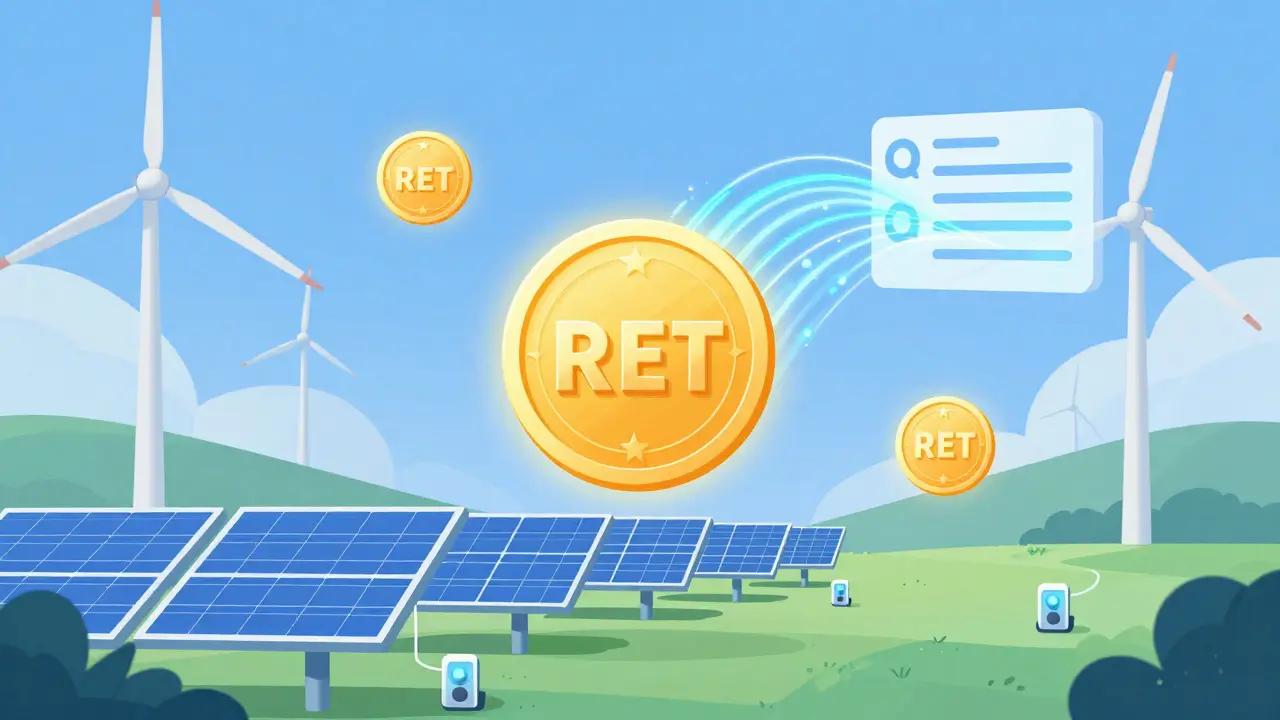
Renewable Energy Token (RET) isn’t just another cryptocurrency-it’s a digital claim to real electricity generated by wind, solar, or hydro power. Think of it like a digital receipt that proves you’ve supported clean energy. Unlike Bitcoin or Ethereum, which rely on mining or staking for value, RETs are tied directly to physical energy production. Each token represents exactly one megawatt-hour (MWh) of renewable electricity that’s been generated, verified, and recorded on a blockchain. This isn’t speculation. It’s a tool to make green energy more transparent, tradable, and accessible to everyone-from big corporations to homeowners.
How RETs Are Created and Verified
Every time a solar farm produces 1,000 kWh of electricity, a smart meter connected to a blockchain system records the exact time, location, and amount. That data gets locked into a digital token-one RET. This process happens automatically through IoT sensors and energy-grade smart meters that meet international standards like IEC 61850. No human enters the numbers. No paperwork is filed. The system does it all in real time.
These tokens are minted only after third-party auditors confirm the energy came from a certified renewable source. No coal, no gas, no nuclear. Just solar panels, wind turbines, or hydro dams. The Energy Web Chain, one of the most widely used blockchains for this, processes these tokens with near-zero energy use-just 0.0003 kWh per transaction. That’s 99.99% less than early Bitcoin mining.
Once created, RETs can be bought, sold, or retired. When a company like Google or Apple wants to prove it’s using 100% renewable energy, it doesn’t just say so. It buys RETs equal to its electricity use and then permanently removes them from circulation. This is called retirement. It’s like burning a receipt to prove you paid for something. Once retired, that token can’t be used again. That’s how you avoid double-counting.
RETs vs. Traditional Renewable Energy Certificates (RECs)
For years, companies used Renewable Energy Certificates (RECs) to claim clean energy use. But RECs are messy. They’re tracked in centralized databases that can be hacked, duplicated, or delayed. Settlement can take weeks. Verification is often manual. In 2023, a MIT study found 18% of sampled RECs had no real metering data attached.
RETs fix this. Because they’re on a blockchain, every step is public, permanent, and tamper-proof. A RET’s metadata includes:
- Exact GPS coordinates of the energy source (within 0.001 degrees)
- Timestamp of generation (down to the minute)
- Type of renewable source (solar, wind, etc.)
- Verification authority
- Unique cryptographic signature
Prices reflect this transparency. RECs trade between $0.50 and $5.00 per MWh. RETs? Between $0.75 and $6.50. The extra cost? You’re paying for certainty. And speed. RETs settle in minutes, not days. In the EU, 97.3% of corporate renewable claims now use blockchain-based retirement-up from 12% in 2022.
Major RET Platforms and Their Differences
Not all RETs are the same. There are at least 12 major platforms, each with different rules. Here are three key ones:
| Platform | Blockchain Used | Token Granularity | Unique Feature | Transaction Fee |
|---|---|---|---|---|
| Energy Web Token (EWT) | Energy Web Chain | 1 RET = 1 MWh | Optimized for energy grids, low energy use | 0.05% |
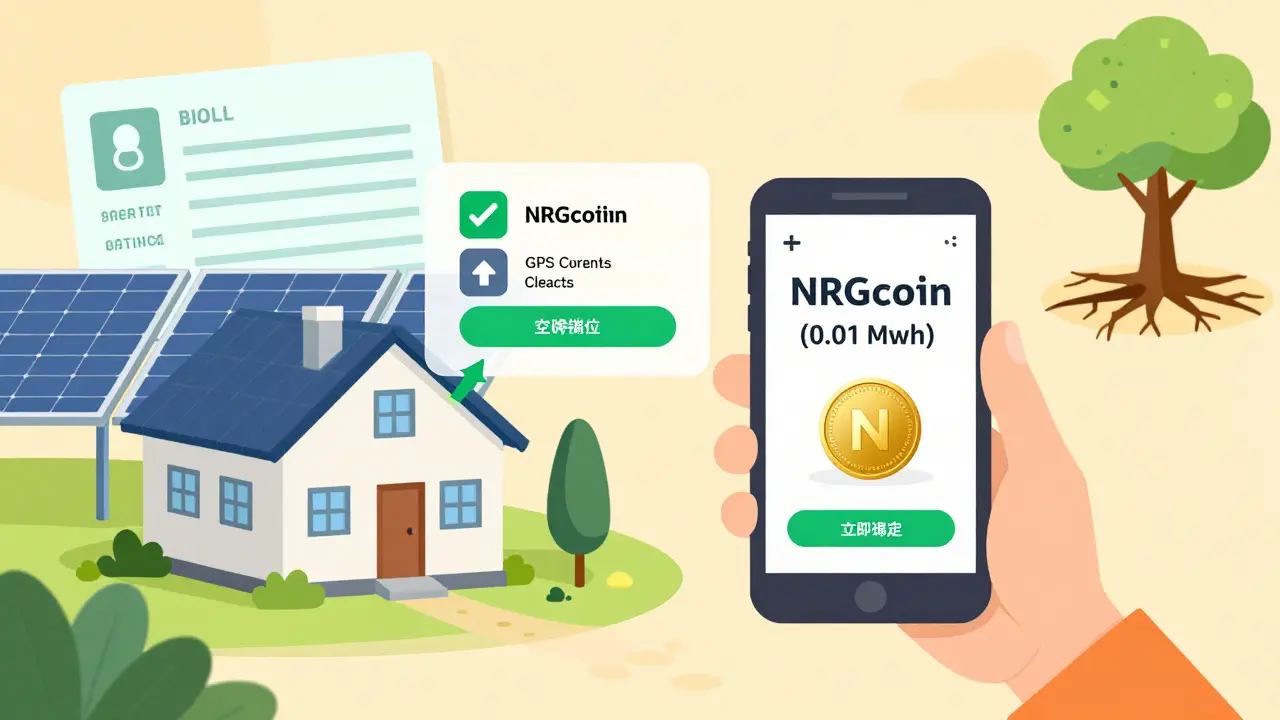
| NRGcoin | Ethereum | 1 NRGcoin = 0.01 MWh | Smallest unit available, good for small buyers | 0.12% |
| GreenCoin | Custom GPoS | 1 GreenCoin = 1 MWh | Higher rewards if mined in high-renewable regions | 0.20% |
NRGcoin lets you buy as little as 10 kWh worth of green energy-perfect for a small business or a single home. Energy Web Token is the most trusted for large-scale corporate use. GreenCoin rewards users for supporting regions with already clean grids, encouraging more investment in renewable-rich areas.

Who Uses RETs and Why
Fortune 100 companies are leading the charge. In 2025, 68 of them used RETs to back 23.7% of their renewable energy claims-up from 41 companies in 2023. Why? Because regulators are catching up. The EU’s Renewable Energy Directive III now requires blockchain-tracked RETs for all corporate claims by 2027. In the U.S., it’s patchy. California and New York have clear rules. Most other states don’t.
But it’s not just big players. Individuals can buy RETs too. Platforms like Powerpeers and Energy Ledger let you purchase tokens to offset your home electricity use. You don’t need to install solar panels. You just buy the proof that someone else did-and your usage gets matched to clean energy.
For renewable energy producers, RETs are a new income stream. A wind farm owner might sell electricity to the grid for $30/MWh. But if they also sell the RET, they get another $4-$6/MWh. That extra cash helps fund new projects. It turns clean energy from a cost center into a revenue generator.
The Downsides and Risks
RETs aren’t perfect. One big issue? Blockchain isn’t magic. If the smart meter is faulty, the token is fake. A Reddit user named GridOperatorMike said 37% of his initial tokenization attempts failed because old meters couldn’t talk to the blockchain. Upgrading hardware costs money.
Then there’s regulation. 63% of countries have no clear rules for RETs. That means someone could create a fake platform, sell tokens backed by nothing, and disappear. The World Economic Forum gave RETs a 4.2/5 for transparency but only 2.8/5 for regulatory compliance. Gartner says the tech is still at the “Peak of Inflated Expectations.” It’s hype, but not yet fully mature.
And yes, blockchain uses energy-even optimized ones. But the difference is massive. On legacy chains, one RET transaction used 0.15 kWh. On Energy Web Chain, it’s 0.0003 kWh. That’s less than a phone charger uses in 30 seconds. The carbon footprint? Just 0.000014 kg CO2 per transaction. Compare that to the 0.0003 kg CO2 from processing a traditional REC paperwork. RETs are cleaner, even when accounting for their own tech.
How to Get Started with RETs
If you’re a business:
- Check your country’s renewable energy rules. Are RETs recognized?
- Install or audit your energy meters. They need to be ISO 14064-3 certified and IEC 61850 compatible.
- Choose a platform. Energy Web is the safest bet for enterprise use.
- Integrate using their open-source ‘Origin’ software. Average time: 8-14 weeks.
- Buy RETs equal to your annual electricity use and retire them.
If you’re an individual:
- Find a consumer platform like Powerpeers or GreenCitizen.
- Link your utility bill (if supported).
- Buy RETs monthly or annually.
- Track your impact: “I offset 1,200 kWh this year with clean energy.”
Training is available. The Energy Web Chain Academy offers an 80-hour certification course. 78% of people finish it. It’s not for everyone-but if you work in energy, sustainability, or tech, it’s worth it.
The Future of RETs
The global market for renewable energy certificates is $142 billion. RETs make up just $1.2 billion of that-but they’re growing at 38% a year. By 2027, BloombergNEF predicts the RET market will hit $3.8 billion. Only 8-10 platforms will survive. The rest will merge or fail.
The UN just started piloting RETs in its carbon offset program. The International REC Standard Foundation integrated blockchain verification in January 2026. Energy Web’s new ‘Spark’ scaling solution can handle 10,000 transactions per second-ready for mass adoption.
Is this the future of green energy? It’s not a silver bullet. But it’s the most honest one we have. RETs turn vague promises into verifiable facts. They let you see exactly where your clean energy came from. And they give real money to the people building wind farms and solar plants-so they can build more.
If you care about climate change, don’t just reduce your usage. Prove you’re supporting real renewable energy. That’s what RETs do.
Are Renewable Energy Tokens the same as carbon credits?
No. Carbon credits represent reduced or removed greenhouse gas emissions, like planting trees or capturing methane. RETs represent electricity generated from renewable sources. You can have both: a solar farm might sell RETs for the power it makes and carbon credits for the emissions it avoids. But they’re two different things.
Can I mine RETs like Bitcoin?
No. RETs aren’t mined. They’re minted only when renewable energy is actually generated and verified. You can’t create them by running software or using GPUs. The only way to get a RET is to buy one from a generator or platform that has verified energy production.
Is RET crypto a good investment?
RETs aren’t designed as investments. Their value comes from their use in proving clean energy claims-not from price speculation. Some platforms offer small profit shares (like ClimateCoin’s 0.875% revenue distribution), but most RETs are meant to be bought and retired, not held for profit. Treat them like a utility token, not a stock.
Can I use RETs to power my home directly?
No. RETs don’t deliver electricity. They prove that an equivalent amount of clean energy was added to the grid on your behalf. Your home still gets power from the same grid everyone else uses. But by retiring RETs, you ensure that more renewable energy is being produced to match your usage.
What happens if a RET platform shuts down?
If the platform disappears, your RETs are still on the blockchain. As long as the underlying chain (like Energy Web Chain) is active, you can still view, transfer, or retire your tokens using public tools. The real risk is losing access to customer support or buying from a platform that wasn’t properly audited. Stick to well-known, transparent systems.
Final Thoughts
Renewable Energy Tokens are not hype. They’re a practical, digital solution to a real problem: proving you’re using clean energy. They’re not for gamblers or speculators. They’re for people who want to make sure their money supports real wind and solar-not greenwashing. As regulations tighten and companies face pressure to deliver real results, RETs are becoming the standard. The tech is still evolving. But the direction is clear: clean energy needs transparent proof. And RETs are delivering it.
Tom Sheppard
February 2, 2026 AT 11:18Aaron Poole
February 3, 2026 AT 20:09Jerry Ogah
February 5, 2026 AT 08:52Will Pimblett
February 5, 2026 AT 20:38Rico Romano
February 6, 2026 AT 02:10Meenal Sharma
February 7, 2026 AT 09:38mary irons
February 9, 2026 AT 04:49