What is Rocket Pool ETH (rETH)? A Simple Guide to Ethereum's Liquid Staking Token
 Dec, 28 2024
rETH Staking Value Calculator
How rETH Works
rETH represents your share of staked ETH plus rewards. As staking rewards accumulate, the value of 1 rETH increases relative to 1 ETH. For example, 1 rETH today might be worth 1.02 ETH next month.
Starting amount
After 30 days
Note: This is an estimation based on current staking yields. Actual returns may vary due to network conditions and market fluctuations.
Rocket Pool ETH (rETH) is not a new cryptocurrency you buy to speculate. It’s a token that represents your share of Ethereum staking rewards - without needing 32 ETH or running a validator node yourself. If you’ve ever wanted to earn staking rewards on Ethereum but didn’t have enough ETH or technical know-how, rETH lets you do exactly that with as little as 0.01 ETH.
How rETH Works: Staking Made Simple
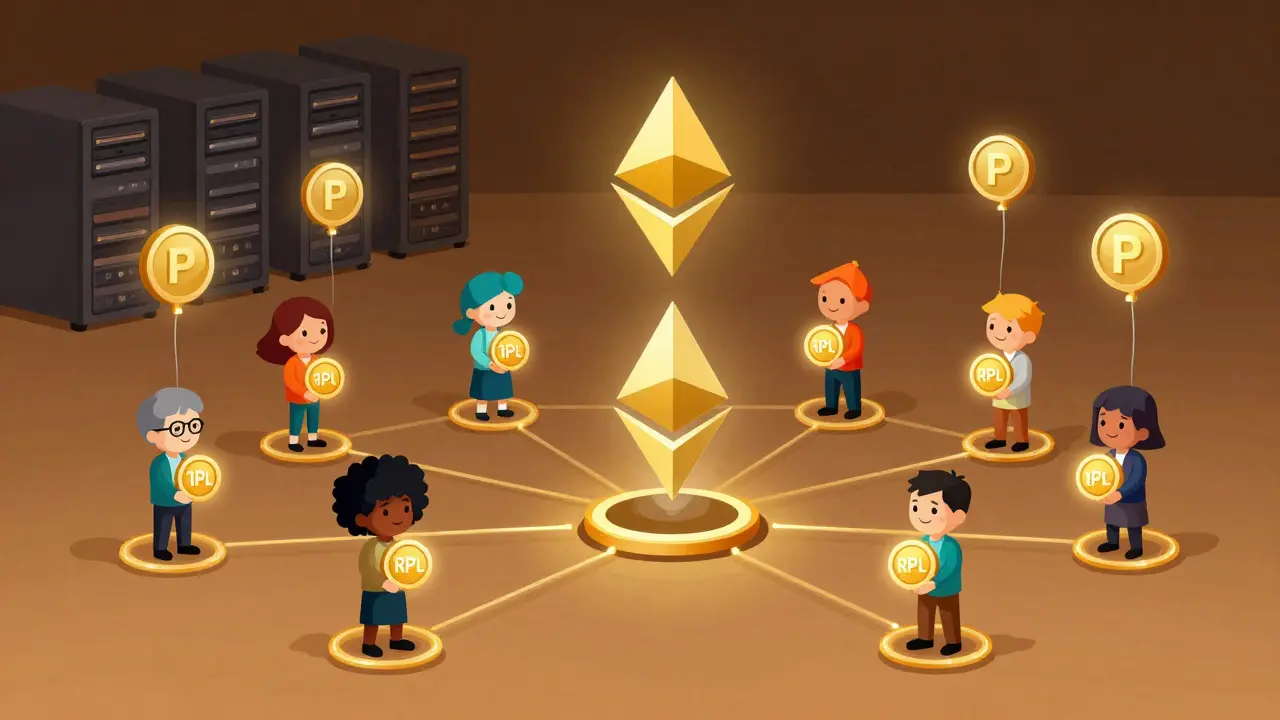
Normally, to earn staking rewards on Ethereum, you need to lock up 32 ETH and run a validator node. That’s expensive, complex, and locks your funds for months or years. Rocket Pool changes that. Instead of doing it alone, you join a shared pool. When you deposit ETH into Rocket Pool, you get back rETH tokens in return. Each rETH token is backed by real ETH staked on the Ethereum network - plus all the rewards that ETH earns over time.
Here’s the key: rETH doesn’t stay at a 1:1 ratio with ETH. As the staked ETH earns rewards - from block proposals, transaction fees, and MEV (Maximal Extractable Value) - the value of rETH rises relative to ETH. For example, if you deposit 1 ETH and get 1 rETH today, next month that 1 rETH might be worth 1.02 ETH. The more rewards accumulate, the more your rETH grows in value. You don’t get extra tokens. You get more value per token.
Why Rocket Pool Is Different from Other Staking Services
Other platforms like Lido (stETH) also offer liquid staking. But Rocket Pool stands out because of how it runs its validators. Instead of relying on a few big companies to run nodes, Rocket Pool uses thousands of independent operators - over 3,000 as of late 2023. Each operator puts up 16 ETH and must lock up 10-150% of their stake in RPL, Rocket Pool’s native token, as collateral. That means no single entity controls too much of the network. It’s designed to be decentralized by default.
This matters. Centralized staking services have been targeted by regulators. In October 2023, the SEC cracked down on platforms offering staking as an unregistered security. Rocket Pool’s decentralized model makes it harder to regulate as a single entity. That’s why many users and analysts see it as a more secure, long-term option for Ethereum staking.
How Much Can You Earn With rETH?
As of November 2023, the annual yield on rETH was around 2.59%. That’s slightly lower than the theoretical maximum of Ethereum’s base staking reward (currently ~4.5%), but it includes extra income from priority fees and MEV. The yield drops a little over time as more people stake ETH, but it’s still better than most savings accounts.
Unlike traditional staking, where rewards are locked until the next Ethereum upgrade, rETH lets you trade or use your tokens right away. You can deposit rETH into DeFi protocols like Aave or Curve to earn even more yield. Some users stack rETH in liquidity pools and earn double rewards - staking yield plus trading fees.
How to Get rETH
Getting rETH is straightforward. You don’t need to install special software or configure a node. Just go to the Rocket Pool website or use a wallet like MetaMask, connect it, and deposit any amount of ETH - even 0.01 ETH. The protocol takes a 0.05% fee, then converts your ETH to rETH at the current exchange rate. The whole process takes 2-5 minutes.
Once you have rETH, it behaves like any other ERC-20 token. You can hold it, send it, trade it on Uniswap or SushiSwap, or use it in DeFi apps. Many wallets, including MetaMask and Ledger, support rETH natively.
What Happens When You Want to Withdraw?
This is where things get a little tricky. You can’t just click “withdraw” and get your ETH back instantly. Rocket Pool has a queue system. When you request to unstake, your rETH is burned, and you’re placed in line to receive ETH back. The wait time depends on how many people are unstaking at once. In normal conditions, it can take a few hours to a couple of days.
If you need ETH fast, you can sell your rETH on a decentralized exchange. But because rETH isn’t as liquid as ETH, you might pay a small premium - usually less than 1%. Most users don’t notice it unless they’re trading large amounts.
Who Should Use rETH?
rETH is perfect for:
- People who have less than 32 ETH but want to earn staking rewards
- Those who don’t want to run a validator node
- DeFi users who want to earn yield while keeping their assets liquid
- Anyone concerned about centralization in staking services
It’s not ideal for:
- People who need instant access to their ETH (like day traders)
- Those who don’t want to deal with any smart contract risk (even though Rocket Pool has been audited multiple times)
- Users who expect guaranteed returns - yields change as more people stake
The Risks of rETH
No system is perfect. Here are the real risks:
- Smart contract risk: Rocket Pool’s code has been audited by top firms like Trail of Bits and Quantstamp. But bugs can still exist. The protocol has never been hacked, but it’s not zero-risk.
- Liquidity risk: If everyone tries to unstake at once, the queue gets long. You might have to wait longer than expected.
- RPL token risk: Node operators must lock up RPL as collateral. If RPL’s price crashes, operators could lose their stake. This doesn’t directly affect rETH holders, but if too many operators get liquidated, it could slow down the network’s growth.
- Regulatory risk: While Rocket Pool is decentralized, regulators could still target exchanges that list rETH. That’s why Coinbase only lets users lend rETH - not stake it directly.

Where Does rETH Stand in the Market?
As of November 2023, the total value locked in liquid staking was $14.7 billion. Rocket Pool held about $1.07 billion of that - roughly 7.3% of the market. Lido still leads with over 31%, but Rocket Pool is growing faster in terms of user count and decentralization.
Its market share has doubled since early 2023. Analysts from Messari and Staking Facilities predict Rocket Pool could reach 10-12% by the end of 2024, especially if Ethereum’s withdrawal delays are reduced as planned in Q2 2024.
What’s Next for rETH?
Rocket Pool’s roadmap includes several upgrades:
- Faster withdrawals - aiming for near-instant unstaking by mid-2024
- Lower collateral requirements for node operators
- Integration with more DeFi protocols and wallets
- Improved user interfaces for non-technical users
They’re also working on making it easier for small stakers to earn RPL rewards - which could give rETH holders an extra incentive beyond just staking yield.
Final Thoughts
rETH isn’t just another crypto token. It’s a tool that lets ordinary people participate in Ethereum’s security and earn real yield without the barriers. It’s not perfect, but it’s one of the most decentralized, transparent, and user-friendly ways to stake ETH today. If you’re looking to earn passive income from your Ethereum without locking it up for years or running complex software, rETH is worth serious consideration.
Is rETH the same as ETH?
No. rETH is a token that represents your share of staked ETH and its rewards. While it’s backed by ETH, its value increases over time as staking rewards accumulate. 1 rETH will eventually be worth more than 1 ETH, not less.
Can I lose my ETH if I stake with Rocket Pool?
You won’t lose your ETH unless the smart contract has a critical flaw - which hasn’t happened yet. Rocket Pool has been audited multiple times, and its design ensures your ETH is always staked securely on the Ethereum network. Your risk is mostly about delays in unstaking or price changes in RPL, not theft or loss of principal.
Do I need to hold RPL to use rETH?
No. RPL is only required for node operators who run validators. As a staker, you only need ETH to deposit and receive rETH. You don’t need to buy or hold RPL at all.
Can I use rETH in DeFi?
Yes. rETH is widely supported in DeFi. You can deposit it into Aave to earn interest, add it to liquidity pools on Uniswap, or use it as collateral in protocols like MakerDAO. Many users earn extra yield by combining rETH staking with DeFi strategies.
Is rETH better than stETH?
It depends. stETH has higher liquidity and is supported by more platforms. But rETH is more decentralized - it doesn’t rely on centralized validators. If you care about Ethereum’s decentralization and long-term security, rETH is the stronger choice. If you want maximum liquidity and ease of use, stETH might be easier.
What’s the minimum amount to start with rETH?
You can start with just 0.01 ETH. That’s less than $20 at current prices. This makes it one of the most accessible ways to stake Ethereum.
How do I know my rETH is safe?
Rocket Pool’s smart contracts have been audited by top security firms like Trail of Bits, Quantstamp, and PeckShield. You can verify the contract addresses on Etherscan. The protocol is also open-source, meaning anyone can review the code. Plus, your ETH is always staked directly on the Ethereum Beacon Chain - not held by a company.
Will rETH ever be listed on Coinbase?
Coinbase already supports rETH for lending in its DeFi yield product, but you can’t stake ETH directly through Coinbase to get rETH. It’s possible Coinbase will list rETH for trading in the future, but no official announcement has been made.
How often do rETH rewards update?
Rewards are calculated and added to the rETH exchange rate continuously, every time a new block is added to Ethereum (every ~12 seconds). Your rETH balance doesn’t change, but its value in ETH increases automatically.
What happens if Rocket Pool shuts down?
Rocket Pool is a decentralized protocol - there’s no company to shut down. Even if the team disappeared, the smart contracts would keep running. Your ETH would still be staked on Ethereum, and you could still unstake through the protocol’s code. The worst-case scenario is a longer withdrawal queue, not loss of funds.
If you’re looking to earn real yield from Ethereum without the hassle, rETH is one of the cleanest options available. It’s not magic - it’s just smart design. And for many, that’s enough to make it the best way to stake ETH today.
justin allen
December 5, 2025 AT 02:31rETH? More like r-ehh-t, because this whole thing feels like a crypto Ponzi with a fancy whitepaper. They say it's 'decentralized'-yeah, right, until the RPL token crashes and half the validators get liquidated. Then what? You're stuck waiting in a queue while the dev team ghosts you. This isn't innovation-it's financial theater with a blockchain glitter finish.
ashi chopra
December 6, 2025 AT 14:41I love how Rocket Pool lets even small stakers join-my cousin in Mumbai deposited just 0.02 ETH and now she’s earning passive income without touching code. It’s beautiful to see tech empower people who’ve been locked out for so long. I don’t care about the debates-this is real change, quiet and steady.
Alan Brandon Rivera León
December 7, 2025 AT 11:34It’s interesting how rETH balances accessibility with decentralization. Most people don’t realize that Lido’s centralized validators are basically proxies for big exchanges-Rocket Pool’s operator model is genuinely different. And yeah, the yield is lower than 4.5%, but you’re not paying for that with trust. Also, the fact that you can use rETH in DeFi without wrapping it? That’s underrated. I’ve got mine in Aave and Curve, stacking yield like a nerd. No drama, just math.
Jess Bothun-Berg
December 9, 2025 AT 07:16Wait. So you're telling me... that I can't withdraw instantly? And there's a 'queue'? And if everyone unstakes at once-oh no!-I might have to wait DAYS? And you call this 'liquid'? That's not liquid-that's a slow-motion trap. Also, '16 ETH collateral'? That's not decentralization-that's gatekeeping with a side of RPL anxiety. And don't even get me started on the 'audits'-audits don't prevent exploits, they just make the lawyers feel better. And why is the yield only 2.59%? Because the protocol is already bloated with suckers. Stop selling vapor.
Murray Dejarnette
December 10, 2025 AT 01:02Bro. I just deposited 0.05 ETH and now I’m earning more than my savings account. Like, actual money. I’m not a degens, I’m just trying to make my crypto work for me. rETH is the only way I’m not just HODLing into oblivion. And yeah, the queue is a thing-but I can sell it on Uniswap for 0.995 ETH if I need cash. That’s not a flaw, that’s flexibility. Stop overthinking it. Just stake. You’ll thank me later.
Sarah Locke
December 11, 2025 AT 00:16For anyone new to staking: rETH is one of the most thoughtful, user-first solutions in DeFi today. You don’t need to be a coder. You don’t need 32 ETH. You don’t need to trust a corporation. You just need to understand that your ETH is being used to secure Ethereum-and you’re being rewarded for it. The risks? Yes, they exist. But they’re transparent, documented, and far less dangerous than trusting a centralized exchange to ‘stake for you.’ This isn’t just a product-it’s a movement toward financial sovereignty. And if you’re still skeptical? Try 0.01 ETH. The math speaks louder than the fear.
Paul McNair
December 12, 2025 AT 18:42Just saw someone say rETH is 'worse than stETH because it's less liquid.' But here's the thing-liquidity isn't everything. If you care about Ethereum's soul, you care about who runs the nodes. Lido's validators? Mostly centralized. Rocket Pool? Thousands of independent operators with skin in the game. That’s not a feature-it’s a moral stance. And honestly? I’d rather have slightly less liquidity and a truly decentralized system than a shiny, centralized proxy that regulators can shut down tomorrow. This isn't finance-it's infrastructure. And infrastructure should be resilient, not convenient.