What is ZyFAI (ZFI)? A Guide to the DeFi Yield Automation Agent
 Apr, 4 2026
Imagine if you had a professional fund manager who lived inside your digital wallet, constantly hunting for the best interest rates and moving your money the second a better deal appeared. You wouldn't have to spend hours staring at charts or manually swapping tokens across different platforms. That is exactly what ZyFAI is a decentralized finance (DeFi) agent platform designed to automate and optimize yield farming across various blockchain protocols. Known by its token ticker ZFI, it removes the tedious manual work of portfolio rebalancing, letting the tech do the heavy lifting while you keep total control of your assets.
The Shift from Zyfi to ZyFAI
To understand where the project stands today, you have to look at its roots. The platform started as Zyfi, a project deeply embedded in the ZKsync ecosystem. They were pioneers in Account Abstraction-a fancy way of saying they made crypto wallets act more like traditional bank accounts, making them easier to use. However, they eventually rebranded to ZyFAI to signal a bigger mission: moving beyond just infrastructure and into the world of autonomous AI agents.
Why the change? Because simply making wallets easier to use wasn't enough. The team realized that the real pain point for most investors isn't just sending tokens, but knowing where to put them to earn the most money without taking insane risks. By shifting to an "agent-based" model, ZyFAI now focuses on creating intelligent bots that execute complex DeFi strategies on your behalf.
How ZyFAI Actually Works
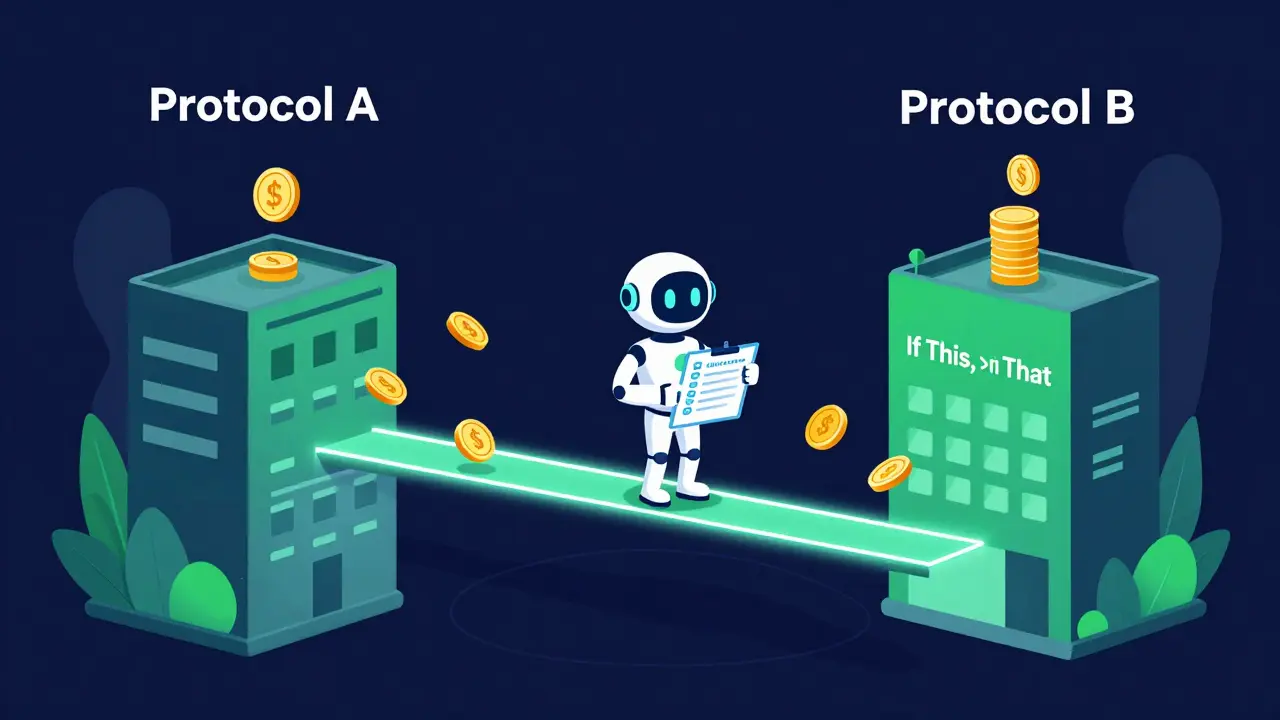
At its core, ZyFAI uses rule-based agents. Think of these as a set of "If This, Then That" instructions for your money. For example, you could set a rule that says, "If the yield on Protocol A drops below 5%, move my funds to Protocol B if it's paying 7%."
The platform analyzes real-time data across the blockchain to find these opportunities. Instead of you manually clicking "Claim" and "Deposit" ten times a day, the ZyFAI agent handles the reallocation automatically. The most critical part here is that it remains self-custodial. This means the agent doesn't "take" your money into a black box; it manages it through smart accounts where you still hold the keys.
One of the cool technical leftovers from its original days is the Paymaster-as-a-Service (PaaS) tech. In the ZKsync world, this allows developers to sponsor gas fees for their users. This means a DApp could literally pay for your transaction costs, removing one of the biggest hurdles for new crypto users who don't have the native token to pay for gas.
Breaking Down the ZFI Tokenomics
If you're looking at the ZFI token, you're looking at the fuel for this ecosystem. The project has a fixed total supply of 500 million tokens. When the public sale happened back in November 2024, it raised about $200,000, with the public getting a slice of about 4.25% of the total supply.
The market reality for ZFI is currently characterized by high volatility. Depending on which exchange you look at, the price fluctuates significantly, and the market cap remains relatively small-often sitting between $1.1 million and $1.6 million. This makes it a low-cap asset, which generally means higher risk but potentially higher reward if the platform gains mass adoption.
| Attribute | Value |
|---|---|
| Total Supply | 500 Million ZFI |
| Public Sale Raise | $200,000 USD |
| Fully Diluted Valuation (FDV) | ~$20 Million USD |
| Primary Network | ZKsync / Base |
Where to Trade and Liquidity Realities
You won't find ZFI on every single major exchange yet, but it's available on several Decentralized Exchanges (DEXes). If you're trying to buy or sell, you need to be aware of where the liquidity is, or you'll run into "slippage" (where the price changes while you're trading).
- Aerodrome SlipStream: This is the heavyweight for ZFI, handling over 85% of the trading volume. If you want the most stable price, this is usually the place.
- Uniswap V3 (on Base): A decent secondary option with moderate liquidity.
- PancakeSwap V3 (on ZKsync): Available, but with much lower liquidity compared to Aerodrome.
Because the liquidity is concentrated in a few pairs (mostly ZFI/WETH), the price can swing wildly based on a few large trades. It's the classic "low-cap" experience: one big buyer can send the price up 20% in a few hours, and one big seller can do the opposite.
The Pros and Cons of Automated Yield
Automation sounds like a dream, but it's not without its trade-offs. Let's look at the reality of using a tool like ZyFAI compared to manual farming.
The big win is efficiency. You stop leaving money on the table. In the fast-moving world of DeFi, a yield pool that's hot today might be dead tomorrow. An agent can pivot your capital in seconds, whereas a human might not notice for three days. Plus, the low-risk focus of ZyFAI's curated opportunities helps prevent you from accidentally dumping your funds into a "degen" pool that's destined to crash.
On the flip side, you're relying on smart contracts. Even with self-custody, the "rules" the agent follows are written in code. If there's a bug in the contract or a flaw in the agent's logic, it could lead to unexpected outcomes. Also, because ZFI is a relatively new and small token, the price volatility of the token itself can sometimes overshadow the yield you're actually earning from the protocol.

Comparing ZyFAI to Traditional Yield Aggregators
You might be wondering how this differs from something like Yearn Finance. While both aim to maximize returns, the approach is different. Traditional aggregators often use "vaults" where you deposit money into a large pool managed by a strategy. ZyFAI is moving toward a more personalized "agent" approach. Instead of just joining a big pool, you have an agent that follows specific rules tailored to your risk appetite.
| Feature | Traditional Vaults | ZyFAI Agents |
|---|---|---|
| Control | Pooled (Managed by Protocol) | Self-Custodial (Managed by Agent) |
| Customization | Low (One size fits all) | High (Rule-based instructions) |
| Execution | Periodic Rebalancing | Real-time Data Triggered |
| Complexity | Simple Deposit | Requires Setting Rules |
Final Thoughts for Potential Users
If you're tired of the "manual grind" of DeFi, ZyFAI offers a compelling path toward a more passive experience. It's particularly attractive for those already using the ZKsync ecosystem who want to leverage the speed and low cost of Layer 2 solutions. However, as with any low-cap crypto project, the risks are real. The project is still in its growth phase, and the market data shows it's a volatile ride.
The real test for ZyFAI will be whether its agents can consistently outperform manual strategies over a long period and whether they can attract enough liquidity to stabilize the ZFI token. For now, it's a fascinating experiment in merging AI-like autonomy with the transparency of the blockchain.
What exactly is the ZFI token used for?
ZFI is the native utility token of the ZyFAI platform. It serves as the core asset for the ecosystem, allowing users to participate in the platform's growth. While its primary role is as a tradable asset, it is tied to the overall success and adoption of the DeFi yield automation agents.
Is ZyFAI safe for my funds?
ZyFAI utilizes a self-custodial architecture, meaning you maintain control over your private keys. However, like all DeFi tools, there is always a risk associated with smart contract vulnerabilities. It is recommended to only allocate funds you are comfortable risking in an experimental DeFi environment.
How does ZyFAI differ from Zyfi?
Zyfi was the original name of the project, which focused heavily on Account Abstraction and infrastructure on ZKsync. The rebrand to ZyFAI reflects a shift toward "AI agents" and autonomous yield optimization, expanding the project's scope from just infrastructure to active financial management.
Where is the best place to buy ZFI?
Based on trading volume, Aerodrome SlipStream is currently the most liquid venue for ZFI. Other options include Uniswap V3 on the Base network and PancakeSwap V3 on ZKsync, though these typically have lower liquidity and may result in more price slippage.
What is a "yield agent" in the context of ZyFAI?
A yield agent is a piece of software that follows a set of pre-defined rules created by the user. It monitors different DeFi protocols in real-time and automatically moves your assets to the one offering the highest yield (APY) based on those rules, eliminating the need for manual rebalancing.