When Impermanent Loss Becomes Permanent: The Critical Moment for DeFi Liquidity Providers
 May, 9 2026
You deposit ETH and USDC into a liquidity pool, expecting steady fees. Weeks later, the price of ETH skyrockets. You check your dashboard and see a red number labeled "Impermanent Loss." It feels like a warning, not a final verdict. But here is the hard truth that trips up most new providers: that loss stays "impermanent" only as long as you keep your assets locked in the pool. The moment you click withdraw, that theoretical deficit crystallizes into real, irreversible money lost.
Understanding exactly when impermanent loss becomes permanent is the single most important skill for anyone providing liquidity in decentralized finance (DeFi). It isn't about avoiding price changes-it's about managing the exit strategy. If you don't know the mechanics of this crystallization event, you might pull out at the worst possible time, locking in losses that trading fees can never cover.
The Mechanics of Crystallization
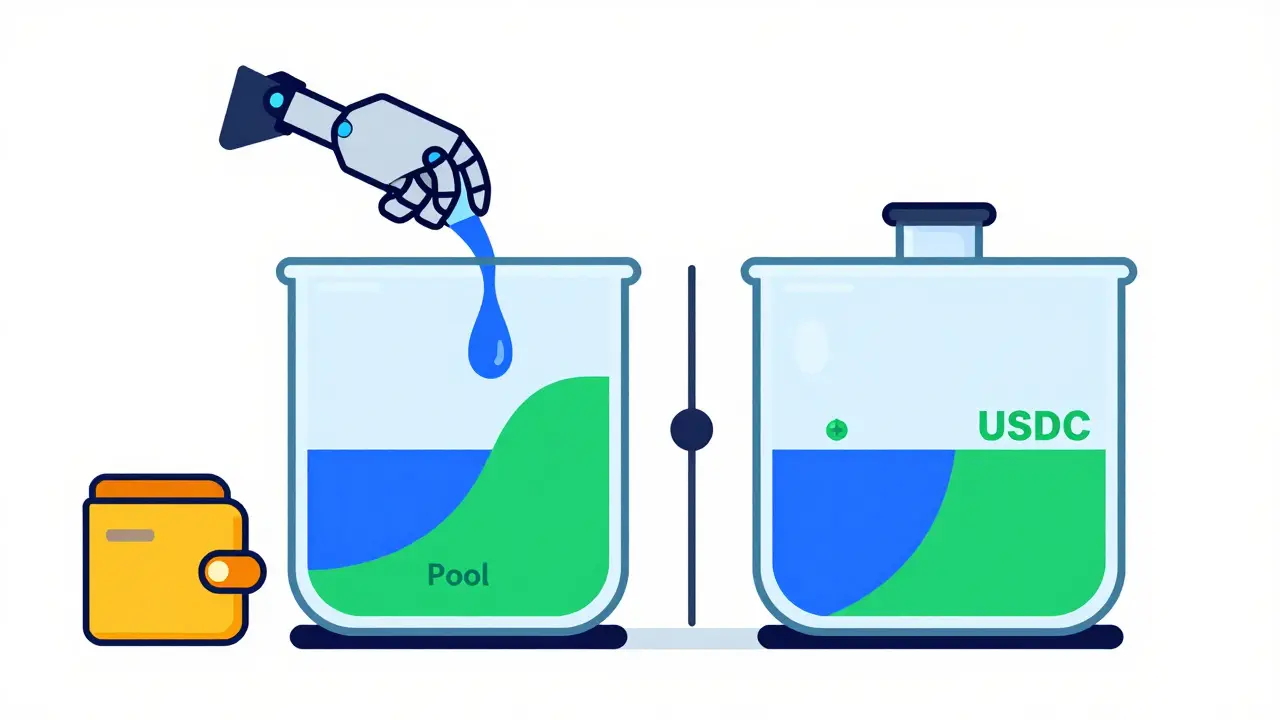
To understand why the loss becomes permanent, you first need to look at how Automated Market Makers (AMMs) work. Protocols like Uniswap use a constant product formula (x * y = k) to set prices. This means if someone buys ETH from the pool, the amount of ETH goes down and the amount of USDC goes up, automatically adjusting the price.
When you provide liquidity, you deposit two assets in equal value. Let's say you deposit $1,000 worth of ETH and $1,000 worth of USDC. If the price of ETH doubles, arbitrage bots will instantly buy cheap ETH from your pool and sell it elsewhere. Your pool now holds less ETH and more USDC than when you started. You still have the same total value relative to the pool, but your ratio has changed.
This is where "impermanent loss" lives. As long as you stay in the pool, you hold that skewed ratio. If ETH prices eventually return to their original level, your ratio rebalances back to normal, and the loss disappears. That is why it is called "impermanent." However, if you decide to withdraw while the price is still high, you are forced to sell your remaining ETH at a disadvantage compared to simply holding the original tokens in your wallet. That withdrawal action is what makes the loss permanent.
The Exact Moment of Conversion
There is no gradual slide into permanent loss. It is a binary event. According to Dr. Georgios Konstantopoulos, Chief Scientist at Paradigm, the moment of withdrawal is the crystallization event. Before you withdraw, the loss is just a comparison metric-a ghost number showing what you would have had if you hadn't provided liquidity. After you withdraw, it is actual capital destruction.
Consider this scenario:
- Deposit: 1 ETH ($1,000) + 1,000 USDC.
- Price Change: ETH rises to $2,000.
- Pool Rebalance: Arbitrageurs take some ETH, leaving you with ~0.707 ETH and ~1,414 USDC.
- Value Check: Your pool position is worth ~$2,828. If you had just held, you'd have 1 ETH ($2,000) + 1,000 USDC = $3,000.
- The Gap: You are "down" $172 (about 5.7%).
If you leave the pool open, that $172 gap remains theoretical. If ETH drops back to $1,000, your pool rebalances, and you break even (plus fees). But if you withdraw now, you receive 0.707 ETH and 1,414 USDC. You cannot magically turn that 0.707 ETH back into 1 ETH without buying more on the open market. The loss is locked in forever.
Factors That Accelerate Permanent Loss
Not all pools treat impermanent loss the same way. The structure of the protocol you choose dictates how quickly and severely losses become permanent upon withdrawal.
| Pool Type | Mechanism | Risk of Permanent Loss | Best For |
|---|---|---|---|
| Uniswap V2 (Standard) | Full range liquidity (0 to infinity) | Low frequency, moderate severity | Beginners who want passive exposure |
| Uniswap V3 (Concentrated) | Narrow price ranges | High frequency, high severity | Active managers who monitor prices daily |
| Curve Finance (Stablecoin) | Stableswap bonding curve | Very low (unless depeg occurs) | Capital preservation and low risk |
| Volatile Pairs (e.g., New Token/ETH) | Standard AMM | Extremely High | Speculative traders with high fee expectations |
In Uniswap V3, concentrated liquidity amplifies this effect. By setting a narrow price range (e.g., $1,800-$2,200 for ETH), you earn higher fees because your capital is working harder. However, if ETH breaks above $2,200, your position converts entirely to the other asset (USDC). You miss out on further ETH gains completely. If you then withdraw after ETH rallies to $3,000, your permanent loss is significantly worse than it would have been in a standard V2 pool. The trade-off is clear: higher potential fees come with a much sharper cliff for permanent loss.
Can Fees Offset Permanent Loss?
This is the million-dollar question. Many providers believe that earning trading fees will naturally cover any impermanent loss. In reality, this is rarely true for volatile pairs unless you are extremely active.
A study by Gauntlet Network found that in Uniswap V3 pools with low fee tiers (0.05%), over 62% of positions experienced permanent loss that exceeded their fee income during periods of high volatility. To break even, the fees earned must exceed the divergence loss. For a 2x price increase, you need to earn enough fees to cover that 5.7% gap plus any additional slippage or gas costs.
In practice, this means:
- High Volume Pairs: Pairs like ETH/USDC or WBTC/ETH often generate enough volume to offset small amounts of impermanent loss over time.
- Low Volume Pairs: Obscure token pairs rarely generate enough fees to cover the risk of price divergence. Here, permanent loss is almost guaranteed upon withdrawal.
Always calculate the "break-even volume" before entering a pool. If the annualized fee yield doesn't comfortably exceed the expected volatility of the asset, you are likely gambling rather than investing.

Strategies to Avoid Crystallizing Losses
You cannot stop price movements, but you can control when you withdraw. Here are practical strategies to prevent impermanent loss from becoming permanent:
- Stick to Correlated Assets: Providing liquidity for stablecoins (e.g., USDC/USDT) or highly correlated assets (e.g., WETH/ETH) minimizes divergence. These pairs rarely experience significant price gaps, so permanent loss is negligible.
- Withdraw During Normalization: Monitor price charts. If you entered when ETH was $1,800 and it spiked to $2,500, wait. If it drops back to $1,900, the ratio normalizes, and the impermanent loss shrinks toward zero. Withdrawing at this point locks in minimal loss.
- Use Concentrated Liquidity Wisely: In Uniswap V3, set ranges that match your price prediction. If you think ETH will stay between $2,000 and $2,500, set your range there. If it exits the range, consider withdrawing or adjusting rather than letting it sit idle as one-sided exposure.
- Set Hard Stop-Losses: Decide beforehand what percentage of loss you are willing to accept. If the impermanent loss hits 10%, withdraw regardless of fees. This prevents emotional decision-making during panic or euphoria.
Tools like ILmentors.app or CoinGecko’s Impermanent Loss Calculator can help you visualize these scenarios in real-time. They show you exactly how much you stand to lose if you withdraw right now versus waiting for price reversion.
The Future of Impermanent Loss Protection
The industry is aware of this pain point. Newer protocols are experimenting with solutions. Bancor 3.0 introduced "loss protection" mechanisms that allow providers to hedge against impermanent loss using derivatives. Balancer’s Linear Pools offer reduced impermanent loss for specific asset combinations. Meanwhile, research teams at Ethereum Foundation are exploring Dynamic Automated Market Makers (DAMMs) that could theoretically eliminate this risk entirely by adjusting bonding curves based on external oracle data.
However, until these technologies become mainstream, the math remains unchanged. Impermanent loss is a feature, not a bug, of constant-product AMMs. It exists to ensure liquidity is always available for traders. Your job as a provider is to recognize that the loss only matters when you exit. Treat every withdrawal as a critical decision point, not just a routine transaction.
Does impermanent loss disappear if I never withdraw?
Technically, yes. As long as your assets remain in the pool, the loss is only theoretical. If prices revert to your entry ratio, the impermanent loss goes to zero. However, keeping assets locked indefinitely carries opportunity cost and smart contract risk. You also miss out on potential gains if you could have reinvested those funds elsewhere.
Can I avoid permanent loss by swapping my tokens back manually?
No. When you withdraw from an AMM, you receive the current ratio of tokens in the pool. Swapping them back on another exchange won't restore the original value because the market price has already moved. The loss is inherent to the price divergence, not the act of swapping.
Is impermanent loss the same as a market crash?
No. Impermanent loss occurs even if both assets go up in price, as long as they move at different rates. For example, if ETH doubles and USDC stays flat, you experience impermanent loss compared to holding. A market crash involves absolute value decline, whereas impermanent loss is relative performance difference.
Why do experts call it "divergence loss" instead?
Some experts, like Dan Robinson of ParaFi Capital, argue that "impermanent loss" is a misnomer because the loss is real upon withdrawal. "Divergence loss" better describes the phenomenon: it measures the difference between the value of holding assets versus providing liquidity due to price divergence. This term emphasizes that the loss is a structural outcome of the AMM model, not just a temporary glitch.
What is the safest pair to provide liquidity for?
Stablecoin pairs (like USDC/USDT) are the safest because they have near-zero price divergence. Since both assets peg to the dollar, they rarely move apart, minimizing impermanent loss. However, yields are typically lower. For higher yields with moderate risk, blue-chip pairs like ETH/USDC or WBTC/ETH are common choices, but they require active monitoring to manage divergence.