Why Trading Volume Plunged After Crypto Restrictions in 2025
 Feb, 12 2026
When Bitcoin hit a new all-time high in May 2025, you’d expect trading volumes to surge. Instead, they collapsed. Top centralized exchanges saw a 27.7% quarterly drop in spot trading volume - from $5.4 trillion in Q1 to just $3.9 trillion in Q2. That’s not a market correction. That’s a regulatory earthquake.
The cause? Not a crash in demand. Not a loss of interest. But the sudden, sweeping enforcement of new rules that forced exchanges to choose: comply and lose users, or flee and lose legitimacy.
How Regulations Killed Volume - Not Price
For years, crypto markets followed a simple pattern: price goes up, volume goes up. More people buy, more people trade, more money flows in. That logic broke in 2025. Bitcoin rose over 30% in Q2. Ethereum climbed 22%. Yet the total volume on the biggest exchanges shrank. Why?
Because regulators didn’t just slow trading - they rewrote the rules of who could trade what, where, and how.
The U.S. passed the GENIUS Act in mid-2025. It didn’t ban crypto. It banned everything that didn’t meet rigid standards. Stablecoins had to be backed 1:1 with U.S. dollars. Exchanges had to register as money transmitters. Users needed multi-layered KYC. Tokens that didn’t meet compliance thresholds were delisted overnight.
Crypto.com, once the second-largest exchange by volume, took the hit hardest. It chose full compliance. Result? Volume plunged 61.4% in one quarter - from $560 billion to $216 billion. It fell from #2 to #8 globally. Meanwhile, Binance, Kraken, and Coinbase all saw volume drops between 15% and 20%. The market didn’t die. It got smaller - and more controlled.
The Global Patchwork: Who Got Hit Hardest
Not all countries reacted the same. The difference between a 7% volume drop and a 22% drop came down to clarity.
Japan and Switzerland kept rules clear and consistent. Exchanges there saw volume fall only 7.3% on average. Why? Because traders knew what was allowed. They could plan. They could adjust.
India, the UK, and parts of the EU? Chaos. Rules changed every few months. One week, a token was legal. The next, it was banned. Users got locked out. Withdrawals stalled. Exchanges scrambled to restructure. Volume in those regions dropped an average of 22.1%.
The EU’s MiCA framework was the exception. It didn’t crush activity - it redirected it. By giving legal status to euro-backed stablecoins like EURC, it created a new, compliant lane for institutional money. EURC’s monthly volume exploded from $47 million to $7.5 billion in just one year. That’s not a decline - that’s a pivot.

Who Won? Who Lost?
While most exchanges shrank, three quietly grew: MEXC, HTX, and Bitget. How? They didn’t fight the U.S. rules. They moved.
MEXC shifted its primary operations to the UAE. HTX leaned into Southeast Asia. Bitget expanded its license in Singapore. They didn’t chase U.S. users. They chased the ones who still wanted to trade - and weren’t afraid of less-regulated zones.
Meanwhile, U.S.-focused platforms like Crypto.com and Coinbase watched their user satisfaction scores crash. Trustpilot ratings for major exchanges dropped from 4.3 to 2.5 stars in Q1 2025. Reddit threads exploded with complaints: "My account got frozen." "I can’t trade XRP anymore." "It took 17 days to verify my ID."
Users didn’t leave because crypto was risky. They left because it became frustrating.
The Paradox: Less Crime, Less Volume
Here’s the twist no one expected: as volume dropped, crime dropped faster.
Illicit crypto transactions fell from 0.9% of total volume in 2023 to just 0.4% in 2025. That’s a 51% drop. TRM Labs confirmed it: regulation worked. Scammers got cut off. Ransomware payments dried up. Money laundering became harder.
But here’s the trade-off: the same rules that stopped criminals also stopped normal traders. A U.S. investor who wanted to trade Solana for a quick flip? Blocked. A European user who wanted to use a non-EURC stablecoin? Locked out. The system became safer - but less flexible.
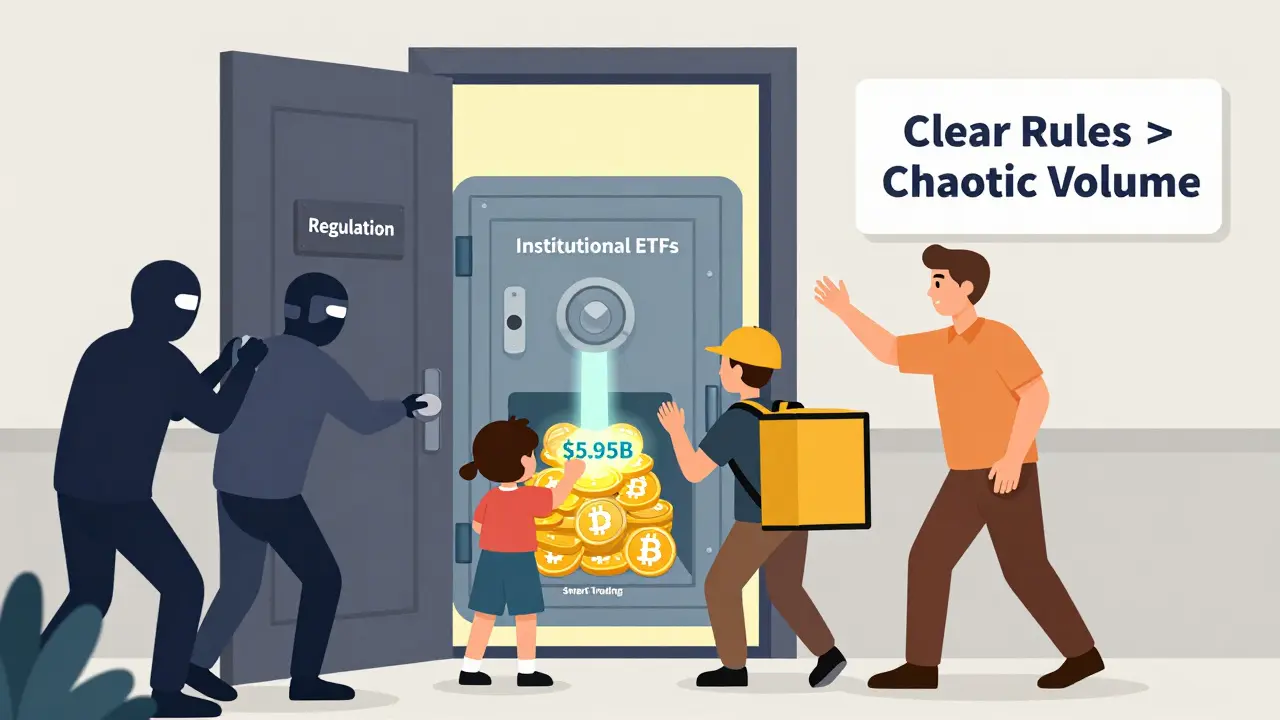
It’s like installing a new lock on your front door. It keeps burglars out. But now your kid can’t get in after school. Your delivery guy can’t leave packages. You have to call someone to open it every time.
What’s Next? The Market Is Adapting
By late 2025, the steepest drops were over. Exchanges had restructured. Users had adapted. Institutions kept coming in - not through exchanges, but through regulated ETFs. In one week in 2025, $5.95 billion flowed into crypto ETFs. That’s real money. Real demand.
Stablecoins, especially USDT and USDC, kept moving. USDC hit $3.29 trillion in monthly volume. Bitcoin’s market share jumped back to 60%. The market didn’t collapse - it consolidated.
The future isn’t about more trading. It’s about smarter trading. The volume isn’t gone. It’s just moving. From unregulated exchanges to licensed platforms. From retail traders to institutional wallets. From chaotic speculation to structured investment.
By Q1 2026, CoinGecko predicts volume will start climbing again. Not because restrictions are gone. But because the market finally has rules everyone understands. The pain was real. The lesson? Regulation doesn’t kill crypto. Bad regulation does.
What This Means for You
If you’re still trading on a U.S.-based exchange, your options are narrower than they were. You can’t trade most altcoins. You’ll face longer verification. Your deposits might be delayed.
If you’re outside the U.S., you might have more access - but you’re also more exposed to risk. The safest path? Stick to regulated assets: Bitcoin, Ethereum, and licensed stablecoins like USDC or EURC.
And if you’re an investor? Stop watching price alone. Watch volume. Watch regulation. Because in 2026, the market that survives won’t be the one with the highest prices. It’ll be the one with the clearest rules.
Why did crypto trading volume drop even though Bitcoin’s price went up in 2025?
Trading volume dropped because new regulations - like the U.S. GENIUS Act - forced exchanges to delist hundreds of tokens, tighten KYC rules, and restrict stablecoin usage. While Bitcoin’s price surged due to institutional demand and ETF inflows, retail trading activity shrank because users lost access to popular altcoins and faced longer verification delays. The market split: regulated assets thrived, while unregulated trading collapsed.
Which exchanges saw the biggest volume drops after crypto restrictions?
Crypto.com suffered the largest drop, with a 61.4% quarterly decline in volume from $560 billion to $216 billion after fully complying with U.S. regulations. Coinbase and Kraken saw 15-20% drops, while Binance’s U.S. operations also contracted sharply. In contrast, MEXC, HTX, and Bitget grew by 3-5% by relocating to jurisdictions like the UAE and Singapore, avoiding strict U.S. compliance.
Did regulations reduce crypto crime, and if so, how?
Yes. Illicit crypto transactions fell from 0.9% of total volume in 2023 to just 0.4% in 2025 - a 51% decline. This happened because regulated exchanges implemented stricter KYC, froze suspicious wallets, and cut off access to mixers and privacy coins. TRM Labs confirmed that regulatory enforcement, not market crashes, was the main driver of reduced criminal activity. The cost? Legitimate traders also faced more friction.
Are there any regions where crypto trading volume didn’t drop?
Yes. Japan and Switzerland saw only 7.3% average volume declines because their regulations were stable and predictable. The EU’s MiCA framework even boosted activity by legalizing euro-backed stablecoins like EURC, whose monthly volume jumped from $47 million to $7.5 billion in one year. India and the U.S. had high adoption despite restrictions, but volume still fluctuated sharply with each new policy announcement.
What’s the long-term impact of these restrictions on crypto markets?
In the short term, volume declined as exchanges and users adjusted. But long-term, regulation is reshaping crypto from a speculative playground into a structured financial market. Institutional money is flowing in through ETFs, stablecoins are becoming banking tools, and compliance is reducing fraud. JPMorgan forecasts stablecoins could drive $1.4 trillion in new dollar demand by 2027. The market isn’t shrinking - it’s maturing.
Should I avoid trading crypto because of these restrictions?
No - but you should trade smarter. Avoid exchanges that are unclear about their compliance status. Stick to Bitcoin, Ethereum, and regulated stablecoins like USDC or EURC. Use platforms with clear licensing (like those based in Switzerland, Japan, or the UAE). The days of trading hundreds of obscure altcoins are over. The future belongs to transparency, not speculation.
Sakshi Arora
February 13, 2026 AT 01:34used to be wild west now its like bank but with more paperwork
my uncle in mumbai still trades on bitget cause he cant wait 3 weeks for kyc
who even is this genius act anyway
bala murali
February 13, 2026 AT 09:18Ekaterina Sergeevna
February 15, 2026 AT 03:57krista muzer
February 15, 2026 AT 20:42like i get it, the scams were bad
but i also miss being able to buy shiba on a whim
now its like you gotta file taxes before you can even open your wallet
and dont even get me started on the 17 day kyc
imagine being a college student and having to prove you exist for 3 weeks just to buy eth
its not safer its just slower
and honestly kinda boring
Peggi shabaaz
February 16, 2026 AT 18:09not gonna lie i was skeptical when i saw the title
but you made me see it differently
its not that crypto died
its just growing up
like a teenager becoming an adult
yeah its less fun
but also way less likely to get arrested
and honestly
if you just stick to btc eth and usdc
youre probably fine
the chaos is over
and maybe thats ok
Holly Perkins
February 18, 2026 AT 11:33Will Lum
February 19, 2026 AT 17:31yeah you lost your favorite memecoin
but now your grandma can invest in a crypto etf without getting scammed
and that’s not a loss
thats progress
the people who got mad were the ones who never cared about crypto
they just liked the thrill
the ones who stuck around? they’re building something real
and honestly
that’s kinda beautiful
Sanchita Nahar
February 21, 2026 AT 07:50