Wyoming Crypto Laws Explained: Why Blockchain Businesses Choose Wyoming in 2026
 Jun, 7 2026
Imagine trying to build a house where the building codes change every time you turn around. That was the reality for cryptocurrency businesses in the United States for most of the 2010s. But then came Wyoming. In just a few short years, this small state with a population of roughly 580,000 transformed itself into the Delaware of Digital Asset Law. If you are looking to launch a blockchain startup, custody crypto assets, or structure a decentralized autonomous organization (DAO), Wyoming offers a level of legal clarity that is hard to find anywhere else.
Why does this matter? Because uncertainty kills innovation. When founders don't know if their token is a security, a commodity, or something entirely new, they hesitate. Wyoming removed that hesitation by passing a comprehensive suite of laws starting in 2018 and accelerating in 2019. Today, it stands as the premier jurisdiction for digital asset businesses seeking stability, privacy, and regulatory certainty.
The Legal Foundation: What Makes Wyoming Different?
Wyoming didn't just tweak existing rules; it wrote new ones specifically for the digital age. The state’s approach is built on several key pillars that work together to create a safe harbor for blockchain innovation.
First, there is the Virtual Currency Act, which explicitly exempts virtual currency activities from the Money Transmitters Act. This means that handling Bitcoin or Ethereum doesn’t automatically trigger the heavy compliance burden associated with traditional money transmission services. Instead, the Wyoming Division of Banking serves as the primary regulator, providing a single point of contact rather than a maze of conflicting agencies.
Second, the state introduced the concept of Open Blockchain Tokens. These are tokens designed for consumptive use-like buying coffee or accessing a service-rather than for investment. Under Wyoming law, these tokens are carved out from certain securities laws, provided specific notice requirements are met. This distinction is crucial because it allows utility tokens to operate without being classified as unregistered securities, a major hurdle in other states.
Third, Wyoming updated its corporate laws to embrace blockchain technology directly. Corporations can now maintain records on electronic networks or databases, including blockchains. Shareholders can be identified by network addresses or private keys, and voting can happen on-chain. This makes it possible to run a company with full transparency and automation, aligning perfectly with Web3 principles.
SPDI Charters: Banking for the Crypto Age
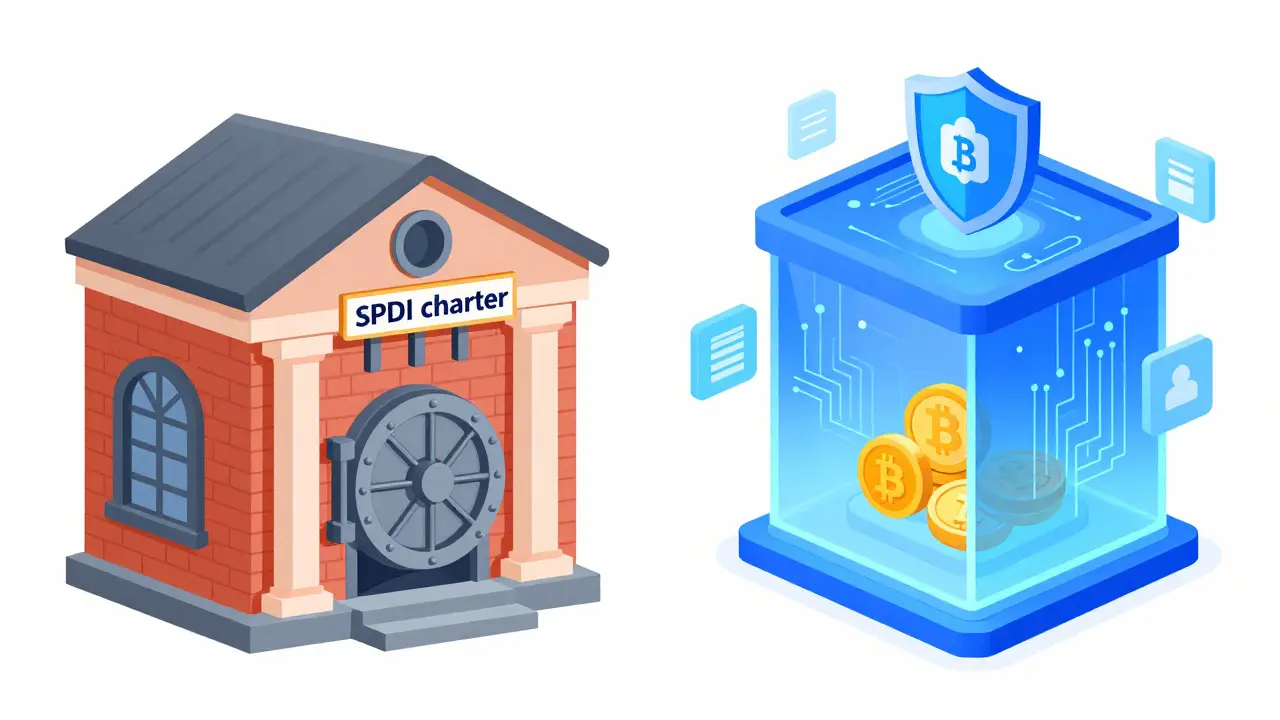
One of Wyoming's most groundbreaking innovations is the Special Purpose Digital Institution (SPDI) charter. Traditional banks were never designed to hold volatile digital assets like Bitcoin. They lacked the infrastructure, the expertise, and the legal framework to do so safely. The SPDI charter changes that.
An SPDI is a bank-like entity authorized to custody digital assets and provide payment services. However, it comes with strict guardrails. SPDIs must maintain specific liquid asset reserves and contingency accounts to ensure solvency. They are prohibited from performing traditional lending activities and their deposits are not insured by the FDIC. This structure protects consumers while allowing institutions to specialize in digital asset custody.
The real-world impact became clear in September 2020 when Kraken, a leading cryptocurrency exchange, became the first entity to receive an SPDI charter. It was also the first crypto exchange to become a U.S. bank. This milestone proved that Wyoming’s framework wasn’t just theoretical-it worked. Since then, other institutions have followed, attracted by the ability to offer secure, regulated custody solutions that comply with both state and federal expectations.
| Feature | Traditional Bank | SPDI Charter |
|---|---|---|
| Custody of Digital Assets | Limited/Restricted | Primary Function |
| Federal Deposit Insurance (FDIC) | Yes | No |
| Lending Activities | Allowed | Prohibited |
| Regulatory Oversight | Federal + State | Wyoming Division of Banking |
| Capital Requirements | Standard Banking Rules | Specific Liquid Asset Reserves |
DAOs and Series LLCs: Structuring Decentralized Organizations
If you are building a decentralized autonomous organization (DAO), you face a unique challenge: how do you give your community legal standing? In most places, DAOs exist in a gray area. Wyoming solved this with the Limited Liability Company (LLC) statute amendment that created the Series LLC framework tailored for blockchain ventures.
A Series LLC allows for separate liability structures within a single entity. This is perfect for managing different projects or asset classes within a larger organization. More importantly, Wyoming recognizes DAOs as legal entities. Members can vote using tokens, and decisions are recorded on the blockchain. This gives DAO members limited liability protection, meaning personal assets are shielded from organizational debts or lawsuits-a critical feature for attracting serious investors and participants.
The Secretary of State oversees these registrations, ensuring that the process is transparent and standardized. By providing a clear path to incorporation, Wyoming has enabled thousands of DAOs to operate legally, reducing risk for developers and users alike.
Tax Advantages and Investor Privacy
Legal clarity is only part of the equation. Financial efficiency matters too. Wyoming offers significant tax benefits that make it attractive for blockchain businesses. There is no state income tax, no corporate franchise tax, and no sales tax on many digital transactions. For startups burning cash to develop technology, these savings can be substantial.
Additionally, Wyoming respects investor privacy. While compliance with anti-money laundering (AML) and know-your-customer (KYC) laws is mandatory, the state does not impose excessive disclosure requirements that could expose sensitive business strategies or investor identities. This balance between transparency and privacy fosters trust without compromising security.
Future-Proofing: The Wyoming Stable Token
Wyoming isn’t resting on its laurels. The state continues to push boundaries with initiatives like the Wyoming Stable Token Commission. Aiming for a July 2025 launch, the WYST (Wyoming Stable Token) will be the first publicly issued stablecoin backed by a U.S. state. This project aims to revolutionize financial transactions by providing a reliable, government-backed digital currency for everyday use.
This move signals Wyoming’s long-term commitment to blockchain leadership. It shows that the state is willing to experiment with public-sector applications of distributed ledger technology, setting precedents that other jurisdictions may follow. For businesses operating in Wyoming, this creates an ecosystem rich in innovation and support.

How to Get Started in Wyoming
So, how do you take advantage of these laws? Here is a practical checklist:
- Determine Your Entity Type: Decide whether you need a traditional corporation, a Series LLC, or a DAO structure. Consult with a lawyer familiar with Wyoming’s digital asset statutes.
- Register with the Secretary of State: File your articles of organization or incorporation. Ensure your documents reflect any blockchain-specific provisions, such as on-chain voting mechanisms.
- Apply for Licenses: If you plan to transmit value or custody assets, apply for the appropriate licenses through the Wyoming Division of Banking. Consider pursuing an SPDI charter if you meet the criteria.
- Implement Compliance Protocols: Even with favorable laws, you must adhere to federal AML/KYC regulations. Build robust internal controls from day one.
- Leverage Local Resources: Partner with local experts, including those at the University of Wyoming, who specialize in blockchain education and integration.
Challenges and Considerations
While Wyoming is undoubtedly friendly, it is not without challenges. The state’s small size means fewer local talent pools compared to tech hubs like Silicon Valley or New York. You may need to hire remotely or relocate staff. Additionally, while state laws are clear, federal regulation remains evolving. Agencies like the SEC and CFTC continue to shape national policy, and businesses must stay vigilant about changing federal guidelines.
Another consideration is the cost of compliance. Obtaining an SPDI charter or maintaining a Series LLC involves legal fees and administrative overhead. However, for most serious blockchain businesses, these costs are outweighed by the benefits of legal certainty and reduced regulatory risk.
Conclusion: Why Wyoming Matters Now More Than Ever
In 2026, the battle for regulatory supremacy in crypto is heating up. Some states are tightening restrictions, while others are lagging behind. Wyoming stands apart by offering a complete, coherent, and forward-thinking legal framework. From SPDI charters to DAO recognition, the state has built an ecosystem where blockchain businesses can thrive without fear of sudden regulatory shifts.
If you are serious about building in Web3, Wyoming should be at the top of your list. It provides the stability, flexibility, and innovation-friendly environment that modern blockchain enterprises need to succeed. Don’t let regulatory ambiguity hold you back-explore what Wyoming has to offer today.
Is Wyoming really the best state for crypto businesses?
Yes, Wyoming is widely considered the most crypto-friendly state due to its comprehensive legal framework, including SPDI charters, DAO recognition, and clear definitions for digital assets. Its proactive legislation reduces regulatory uncertainty, making it ideal for blockchain startups.
What is an SPDI charter and who needs it?
An SPDI (Special Purpose Digital Institution) charter allows entities to custody digital assets and provide payment services under Wyoming law. It is needed by businesses that want to offer regulated crypto custody or banking-like services without holding traditional bank charters.
Can I form a DAO in Wyoming?
Yes, Wyoming allows DAOs to register as legal entities, typically as Series LLCs. This provides members with limited liability protection and enables on-chain voting and governance, giving DAOs a solid legal foundation.
Are there taxes on crypto transactions in Wyoming?
Wyoming has no state income tax or corporate franchise tax, which benefits crypto businesses. However, federal taxes still apply to capital gains and income generated from crypto activities. Always consult a tax professional.
How does Wyoming regulate open blockchain tokens?
Wyoming distinguishes open blockchain tokens used for consumption from securities. If a token meets specific notice requirements and is primarily for utility, it may be exempt from certain securities laws, simplifying compliance for developers.