Yield Farming Tax Guide: How to Handle DeFi Rewards and Gains
 Apr, 28 2026
Most people jump into yield farming because the returns look incredible. You lock up your assets in a protocol, earn some tokens, and watch your balance grow. But there is a catch that often hits users right around April: the IRS doesn't see these rewards as "free money." In the eyes of the tax man, those tokens are taxable events, and if you aren't tracking them, you're walking into a potential audit nightmare.
The biggest headache is that there isn't a single, specific "Yield Farming Rulebook" from the government. Instead, we have to apply existing cryptocurrency tax laws to new decentralized finance (DeFi) tools. This means your rewards could be taxed as ordinary income (which can be as high as 37%) or as capital gains (which can be as low as 0% depending on your bracket). If you're moving funds between pools or swapping rewards, you're creating a paper trail that needs to be documented perfectly.
| Event Type | Tax Classification | Tax Rate Basis | Timing of Tax |
|---|---|---|---|
| Receiving Reward Tokens (e.g., COMP, SUSHI) | Ordinary Income | Current Income Bracket | At time of receipt |
| Interest/Fees from Liquidity Pools | Ordinary Income | Current Income Bracket | At time of receipt |
| Selling Tokens held < 1 Year | Short-Term Capital Gain | Current Income Bracket | At time of sale |
| Selling Tokens held > 1 Year | Long-Term Capital Gain | Preferential (0%, 15%, 20%) | At time of sale |
Understanding Reward Tokens as Ordinary Income
When you provide liquidity to a platform like Uniswap is a decentralized trading protocol that allows users to trade tokens without an intermediary or Aave is a decentralized liquidity protocol where users can lend and borrow assets , you aren't just "staking." You are essentially earning a wage or interest in the form of cryptocurrency. The IRS generally views these rewards as ordinary income.
Here is how it works in a real scenario: Imagine you earn 100 tokens of a new project as a reward on Tuesday. If those tokens are worth $5 each on Tuesday, you have just earned $500 of taxable income. It doesn't matter if you don't sell them immediately; that $500 is added to your total income for the year. This is where many farmers get tripped up-they think they only owe taxes when they "cash out" to USD, but the tax event happens the moment the tokens hit your wallet.
The value you report at the time of receipt also becomes your "cost basis." If those same 100 tokens grow to $10 each and you sell them a year later, you aren't taxed on the full $1,000. You're taxed on the $500 gain (the difference between the $500 cost basis and the $1,000 sale price) as a long-term capital gain.
The Liquidity Pool Trap: More Than Just Rewards
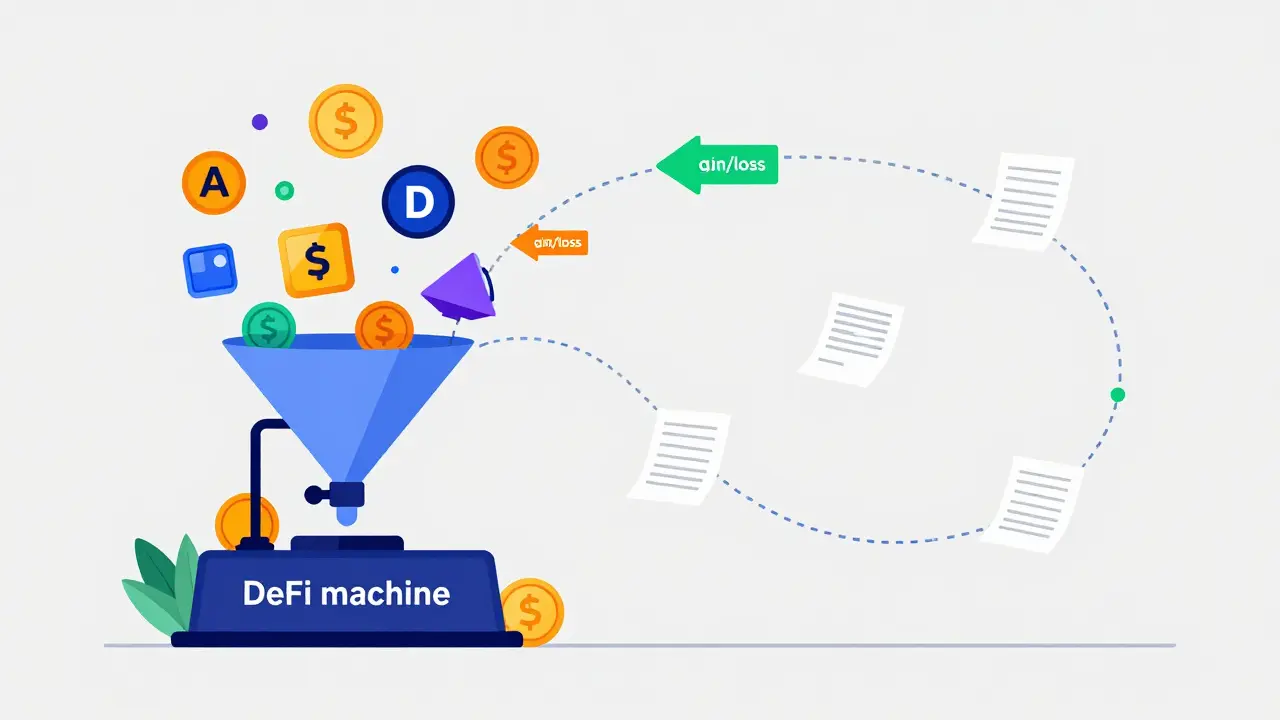
Providing liquidity to an Automated Market Maker is a type of DeFi protocol that uses mathematical formulas to price assets instead of a traditional order book (AMM) introduces a layer of complexity called "taxable swaps." When you deposit two different tokens into a pool, you often receive LP Tokens (Liquidity Provider tokens) in return. These tokens represent your share of the pool.
Depending on how your tax professional views it, depositing tokens into a pool in exchange for LP tokens could be seen as a taxable exchange. While some argue this is a non-taxable contribution, a conservative approach treats it as a swap. If the value of the assets you put in is less than the value of the LP tokens you receive (which happens if the pool has already grown), you might have a taxable gain right at the start.
Furthermore, if you use a "yield aggregator" that automatically moves your funds between different protocols to find the best rate, every single move could be a taxable event. If a bot swaps your Ethereum for a stablecoin and then into a different farming pair, that's a series of trades that each require a calculation of gain or loss.
Navigating the Tax Brackets for 2025-2026
Since yield farming income is mostly treated as ordinary income, it follows the same progressive tax brackets as your day job. For the current tax cycle, a single filer might pay 10% on the first chunk of income, but if you've had a massive year in DeFi, you could easily hit the 37% bracket for income over $609,350.
This creates a massive disparity between how you earn and how you pay. Short-term capital gains (assets held for less than a year) are taxed at these same high ordinary rates. However, if you have the patience to hold your reward tokens for over 365 days, you can qualify for long-term capital gains rates, which are significantly lower (0%, 15%, or 20%). This is why many experienced farmers "harvest" their rewards and then hold them long-term rather than flipping them immediately.
Don't forget about quarterly estimated payments. If you're earning significant income from Compound is an algorithmic, autonomous interest rate control protocol that allows users to earn interest on crypto or PancakeSwap is a decentralized exchange on the BNB Smart Chain that allows users to trade and farm tokens , you shouldn't wait until April 15th to pay. If you expect to owe more than $1,000, the IRS expects quarterly payments to avoid underpayment penalties.
The Record-Keeping Nightmare: Tools and Strategies
Trying to track yield farming via a spreadsheet is a recipe for disaster. Between the thousands of small reward distributions and the fluctuating prices of obscure tokens, manual entry is nearly impossible. You need a system that can handle API integrations with your wallet and the blockchain.
Professional tools like Koinly is a cryptocurrency tax software that automatically tracks transactions and calculates gains and losses or CoinTracking is a portfolio management and tax reporting tool for cryptocurrency investors are essential. These tools pull your transaction history and attempt to match rewards with their fair market value at the exact second they were received.
If you're farming a brand new token that doesn't have a listed price on major exchanges yet, you'll have to manually determine the Fair Market Value (FMV). A good rule of thumb is to use the price from the most reliable decentralized exchange (DEX) available at that moment and screenshot the price chart for your records. If an auditor asks why you valued a token at $0.12, having a timestamped screenshot of the pool price is your best defense.

Common Pitfalls and How to Avoid Them
- Ignoring "Dust" Rewards: You might think a few cents of a token aren't worth tracking, but thousands of these small events can clutter your records and make it look like you're hiding income.
- Confusing Staking with Farming: While similar, some staking events are non-taxable until the token is unlocked. Yield farming, where you receive tokens actively, is almost always taxable upon receipt.
- Forgeting the Gas Fees: Don't leave money on the table. The Gas fees you pay to claim your rewards or move funds between pools can often be used to reduce your overall taxable gain.
- Miscalculating the Cost Basis: If you earn a token at $1, sell it at $5, then buy it back at $3, your basis changes. Failing to track this leads to overpaying taxes.
Is yield farming taxable in the US?
Yes, all yield farming activities are taxable in the United States. The IRS treats rewards-such as interest, fees, and new tokens-as ordinary income based on their fair market value at the time you receive them. Any subsequent increase in the value of those tokens until you sell them is treated as a capital gain.
When is the exact moment a reward becomes taxable?
A reward is generally taxable at the moment you have "dominion and control" over the asset. In most DeFi protocols, this is the moment you claim the reward and it appears in your wallet. If rewards are automatically compounding in a contract and you cannot withdraw them, the tax timing may vary, but the safest approach is to track them upon receipt.
Can I use losses from one pool to offset gains in another?
Yes. You can use capital losses to offset capital gains. If you lost money on a token you were farming, that loss can reduce the total capital gains tax you owe. However, capital losses can only offset ordinary income up to a certain limit (typically $3,000 per year in the US) if your losses exceed your gains.
What happens if the token I earned has no market price?
This is a common challenge with "farm and dump" tokens. You should attempt to find the most accurate price on a DEX like Uniswap or PancakeSwap. If the token is truly valueless or has no liquid market, you may record the value as zero, but you should keep a log explaining why that valuation was used to protect yourself during an audit.
Do I need to file a separate form for DeFi income?
There isn't a specific "DeFi form," but you must report this income on your standard federal tax return. Ordinary income from rewards typically goes on Schedule 1 or is included in your total income, while sales of tokens are reported on Form 8949 and Schedule D for capital gains and losses.
Next Steps for Your Tax Strategy
If you're currently farming, the best thing you can do is start a retrospective audit of your wallets. Connect your public addresses to a crypto tax software today to see where your gaps are. If you're a high-net-worth individual, it's time to stop relying on community forums and hire a Certified Public Accountant (CPA) who specializes in digital assets.
For those just starting, consider a "tax-first" farming strategy. This means choosing protocols with more stable reward tokens that you are comfortable holding for over a year to lock in those long-term capital gains rates. Also, set aside 20-30% of every harvest in a stablecoin vault specifically for your tax bill, so you aren't forced to sell your portfolio at a loss when tax season arrives.
Brendan Thraxton
April 29, 2026 AT 15:41Great breakdown for anyone getting started in DeFi. Just a heads up that using a dedicated wallet for your farming can make the software imports way cleaner and save you hours of sorting through a messy main wallet
Bevon Findley
May 1, 2026 AT 11:10Obviously basic stuff for the real players :) 🥂
Kathleen Warren
May 2, 2026 AT 23:43It can feel really overwhelming when you first see those tax brackets. Please remember that you aren't alone in this confusion and it is okay to take it one step at a time. If anyone is struggling to find a CPA who understands crypto, maybe we can share some resources here to help each other out.
Barbara Jones
May 4, 2026 AT 03:47thnx for the heads up on the gas fees i totatly forgot about that part of the equation. definitely gonna double check my records now lol
Kristi Swartz
May 4, 2026 AT 11:12It is simply wrong to avoid these payments. People who think they can hide their tokens from the government are acting without any moral compass and it is a shame that some of you even try to find loopholes. Law is law and paying your fair share is the only ethical way to participate in these markets regardless of how complex the software is
Tracy McBurney
May 6, 2026 AT 01:32The suggestion to use Koinly is amusingly naive given their recent pricing hikes and the way they handle specific AMM pairs. Let's be honest, the software is barely functional for complex strategies involving multi-hop swaps. You'll end up spending more time fixing their mistakes than you would have spent on a spreadsheet. It's a typical case of a tool promising automation and delivering a headache. Most users are just blindly trusting these platforms with their financial data without realizing the risk of incorrect reporting. You might as well be guessing your taxes at this point. If you're actually making significant money, you shouldn't be reading a guide; you should be paying a professional who doesn't rely on a glitchy API. The reality is that the average farmer is just one audit away from bankruptcy because they think a fancy interface equals compliance. It's almost impressive how people trust these tools so implicitly.