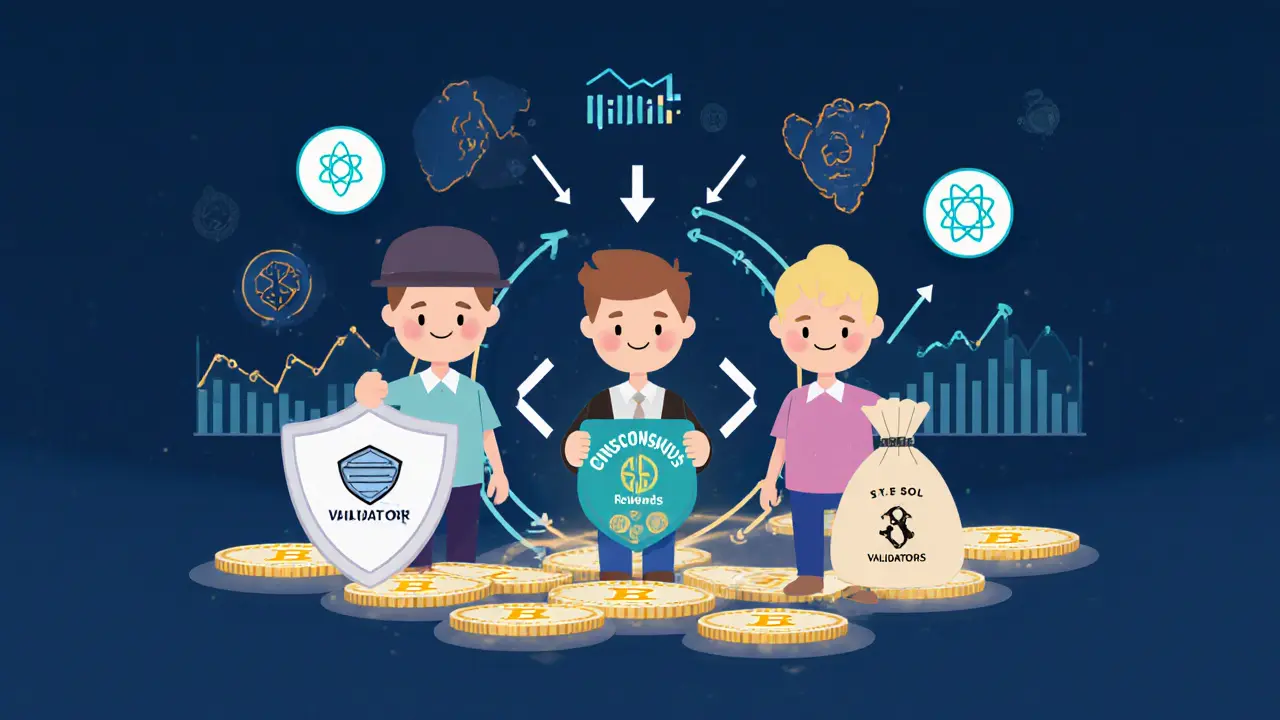
Learn how validators earn rewards in proof-of-stake blockchains like Ethereum and Solana, including consensus and execution layer income, commission structures, slashing penalties, and the risks and rewards of staking.
Blockchain Economics: How Token Design, Airdrops, and Markets Really Work
When you hear blockchain economics, the study of how incentives, scarcity, and governance drive value in decentralized networks. It's not about price charts or memes—it's about why people bother holding a token, joining a network, or risking their seed phrase for a free airdrop. Most crypto projects fail because they ignore the basics: if users don’t get real value, they walk away. And that’s exactly what happened with tokens like BOYS, BUILT, and even FEAR—once the hype faded, so did the users.
tokenomics, the internal economic design of a cryptocurrency. It’s what decides how many tokens exist, who gets them, and how they’re used. Look at RDNT or LON: they give holders voting power or fee discounts, making them useful beyond speculation. But airdrops like CYT, 3ULL, or FLUX? Those are often just marketing tools. They get attention, sure—but if the token has no utility, it’s just digital confetti. And when thousands of people claim the same airdrop, the price crashes because supply explodes overnight. That’s blockchain economics in action: too many tokens chasing too little demand. Meanwhile, platforms like DeFi, a system of financial services built on open blockchains without banks. It’s where RDNT lends across chains, and Serum DEX trades without middlemen prove that real value comes from solving actual problems—not giving away free tokens.
And then there’s the dark side: fake airdrops like Position Exchange’s Times Square billboard or Sonar Holiday. These scams prey on the hope that free crypto is just a click away. But blockchain economics doesn’t work that way. Real value is earned through participation, not luck. That’s why the posts here focus on what actually matters: how tokens are distributed, how exchanges like Coincall or Bitpin handle compliance, and why projects like Archethic or RWA tokenization are trying to fix broken systems. You won’t find fluff here. Just real cases where design worked—or failed.
What follows isn’t just a list of articles. It’s a window into the mechanics behind every crypto project you’ve ever heard of. Whether it’s a dying meme coin, a legitimate DeFi protocol, or a scam pretending to be an airdrop—you’ll see how blockchain economics decides who wins, who loses, and who gets left behind.