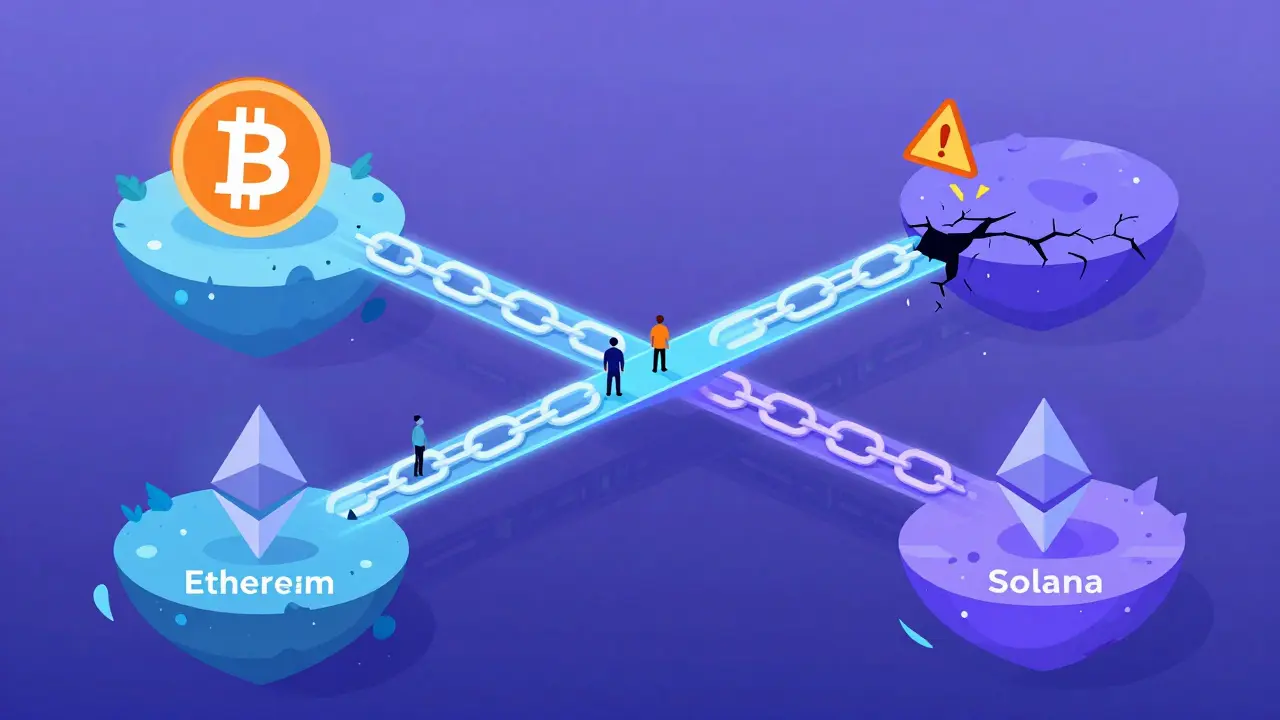
Cross-chain bridges connect isolated blockchains, letting you move assets like Bitcoin to Ethereum for DeFi. But with $2.1 billion stolen in 2022, security is critical. Learn how they work, which ones are safest, and what’s next.
Trust-Minimized Bridge: What It Is and Why It Matters in Crypto
When you move crypto from Ethereum to Solana or from Bitcoin to Polygon, you need a trust-minimized bridge, a system that transfers assets between blockchains without requiring users to trust a central company or operator. Also known as a trustless bridge, it uses smart contracts and cryptographic proofs instead of intermediaries to verify transactions. This is the difference between handing your keys to a friend and using a locked vault with dual keys only you control. Most crypto bridges in 2023 were centralized — companies held the funds, ran the servers, and could freeze or steal your assets. The collapse of Poly Network, Ronin, and Wormhole showed how dangerous that is. A trust-minimized bridge removes that risk by design.
It works by locking your crypto on one chain and minting an equivalent token on another, using verifiable math, not human judgment. Think of it like a notary public who doesn’t need to know your name — they just confirm the signature matches the document. Tools like DeFi, a system of financial applications built on public blockchains without banks or brokers rely on these bridges to connect liquidity pools across networks. Without them, you couldn’t use your ETH on Arbitrum, your SOL on Polygon, or your BTC on Ethereum as wrapped tokens. And because they’re built on open-source code, anyone can audit them. That’s why projects like LayerZero, Axelar, and Chainlink CCIP are pushing trust-minimized designs — they’re not just tech upgrades, they’re security upgrades.
But they’re not perfect. Some still rely on small groups of validators, which creates a new kind of centralization risk. Others have complex code that’s hard to audit. That’s why you’ll see posts here breaking down real cases — like how a bridge failure in 2024 wiped out $200M in user funds, or how a new bridge on Fantom slashed transaction fees by 90% while staying trust-minimized. You’ll also find guides on how to check if a bridge is truly trust-minimized, what red flags to watch for, and which ones actually work in 2025. This isn’t theory. It’s about protecting your money when you move it across chains — and knowing which bridges are worth your trust.